Two procedure codes can each be valid on their own and still be inappropriate together on a Medicare claim. An NCCI PTP edit captures that reporting relationship, but the decision is not simply a matter of spotting a code pair. The claim type, date of service, column order, modifier indicator and documented circumstances all matter.
What Medicare NCCI PTP edits are designed to do
CMS developed the National Correct Coding Initiative (NCCI) to promote correct coding and prevent inappropriate payment when certain procedure or service codes are reported together. A Procedure-to-Procedure (PTP) edit identifies a pair of HCPCS or CPT codes that, in general, should not be reported together under the circumstances addressed by the edit. Medicare applies these edits to services reported by the same provider or supplier for the same beneficiary on the same date of service.
A PTP edit is not a judgment that either procedure is never appropriate. It addresses the relationship between two reported services. Depending on the pair, the concern may be overlapping work, a service already included in another procedure, mutually exclusive procedures or another coding conflict. The same two services may be reportable in a different clinical circumstance, but that conclusion cannot be drawn from the code descriptions alone.
It is also important to keep PTP edits distinct from the other parts of NCCI. PTP edits test relationships between two different codes. Medically Unlikely Edits (MUEs) address an inappropriate number of units for a code on a date of service, while Add-on Code (AOC) edits identify add-on codes and their associated primary codes. They solve different coding problems, so a PTP lookup is only one part of an NCCI-aware validation process. This article focuses on Medicare PTP edits for practitioner and hospital outpatient services, not the separate coding rules used under the Hospital Inpatient Prospective Payment System (IPPS).
A PTP edit also does not decide whether a service is covered, medically necessary or authorized. Those questions may depend on National or Local Coverage Determinations, payer policy, benefit rules and the clinical record. A claim can pass a PTP check and still fail another coverage or payment requirement. Conversely, the presence of a PTP edit does not, by itself, tell a reviewer whether a modifier exception is supported in the case being examined.
Column 1 and Column 2 describe the edit relationship
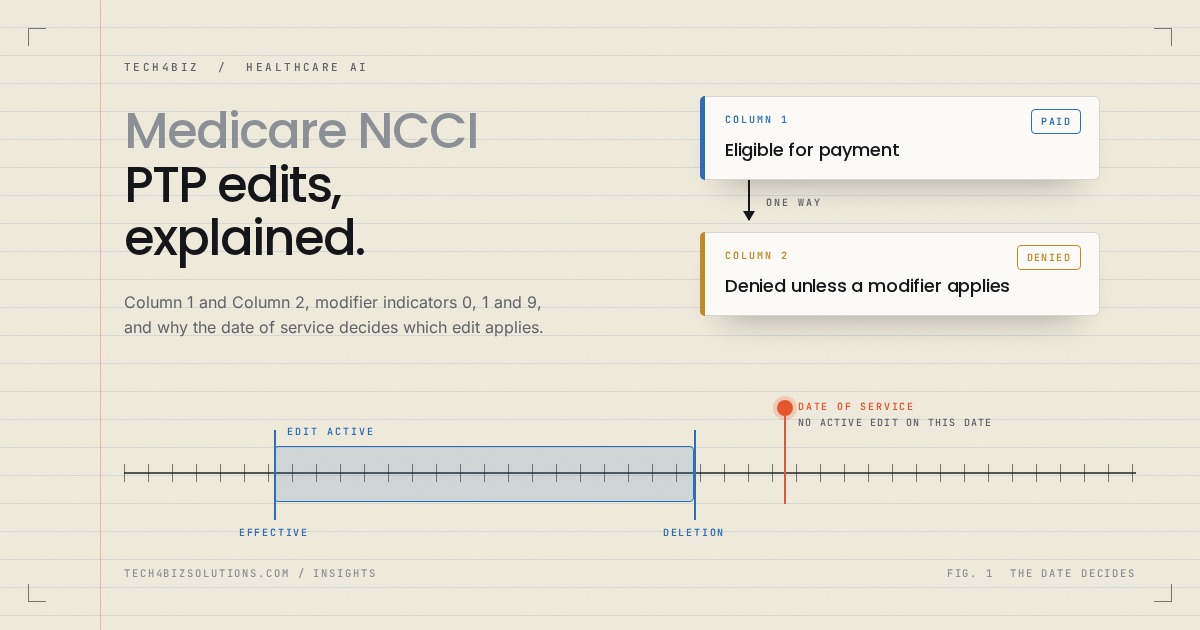
Every PTP edit has a Column 1 code and a Column 2 code. When the same provider or supplier reports both codes for the same beneficiary on the same date of service, the Column 1 code is eligible for payment under the edit, while the Column 2 code is denied unless the edit permits an appropriate NCCI PTP-associated modifier and the circumstances justify its use. The columns therefore have distinct operational roles, and their order must be preserved when the pair is stored, evaluated or explained to a biller.
The labels should not be read as a universal ranking of clinical importance. Column 1 is not always a “main” procedure with Column 2 as a minor component. CMS notes in its Medicare NCCI FAQ Library that Column 2 is often part of a more comprehensive Column 1 service, but that relationship does not describe many edit pairs. Some represent mutually exclusive procedures or other coding conflicts. The rationale behind a pair matters, and the appropriate explanation is found in the NCCI Policy Manual, not by assuming that the second code is always a component of the first.
CMS's guidance on how to read the files describes seven columns in the practitioner PTP tables. The hospital tables work the same way, and the layout of the file you download is the one to rely on:
| Field | What it tells you | Why it matters |
|---|---|---|
| Column 1 | The first code in the edit pair | Establishes the code eligible for payment under the edit when the pair is reported together |
| Column 2 | The second code in the edit pair | Identifies the code generally denied when the edit applies |
| Pre-1996 status | Whether the edit existed before 1996 | Historical context, not the test for whether the edit is active |
| Effective date | The date the edit became effective | Establishes when the edit can apply to a date of service |
| Deletion date | The date the edit was deleted, when applicable | Helps determine whether the edit applied to the date of service being reviewed |
| Modifier indicator | The Correct Coding Modifier Indicator (CCMI) | Shows whether an NCCI-associated modifier may bypass an active edit under appropriate circumstances |
| Edit rationale | The category of rationale for the edit | Names the type of coding conflict behind the pair. The explanation of the policy itself is in the NCCI Policy Manual |
The pre-1996 field is easy to misread as an active-status flag, but it is not one. To determine whether an edit applies, the system needs to evaluate the effective and deletion dates against the date of service. The rationale column gives only a category. The fuller explanation of the coding policy is in Chapter 1 of the NCCI Policy Manual.
Choose the correct PTP file for the claim
Medicare publishes separate PTP edit collections for practitioner services and hospital outpatient services. The correct collection depends on the Medicare claim-processing context, not merely on the building in which a physician happened to perform a service. The hospital outpatient PTP edits are incorporated into the Outpatient Code Editor used for OPPS processing, and CMS also identifies certain other facility claim contexts in its program guidance. Inpatient hospital IPPS claims are outside the scope of Medicare NCCI PTP edits, so an outpatient edit file should never be treated as a general rule set for all hospital claims.
Each collection is split into code-range downloads. CMS's current PTP page lists four files for practitioner services and four for hospital outpatient services. The split is a distribution method, not a change in the underlying policy. A system that loads only one segment has an incomplete lookup, even if the import finishes without an error. The ingestion process should confirm that every expected file for the selected collection and quarter has been received, parsed and activated.
Medicaid has its own NCCI edit publications, and individual states may apply additional policies or local edits. Medicare PTP files should not be treated as a universal rule set for Medicaid, Medicare Advantage or commercial plans. Each program and payer needs to be evaluated against the source material that governs its claims.
As of November 11, 2026, CMS lists the 2026 fourth-quarter Medicare PTP files as version v323r0, effective October 1, 2026 and posted September 2, 2026. The release contains separate practitioner and hospital outpatient files. That version number is a dated reference point, not a permanent label: CMS updates the files at least quarterly, and a new release may add or delete pairs or change modifier indicators. The CMS Medicare PTP page should be checked again when deploying a new rule set.
Read the Correct Coding Modifier Indicator carefully
Every PTP edit is assigned a Correct Coding Modifier Indicator (CCMI). It answers a narrow question: can an NCCI-associated modifier be used to bypass this edit under appropriate circumstances? It does not decide whether a modifier is justified by the clinical facts, and it does not turn a code pair into an automatic pass.
| CCMI | Meaning | Practical effect |
|---|---|---|
| 0 | NCCI-associated modifiers cannot bypass the edit | The Column 2 code is not eligible for payment under the edit when the pair is reported in the applicable context |
| 1 | An NCCI-associated modifier may bypass the edit when appropriate | Both codes may be eligible when the circumstances meet the modifier criteria and the record supports them |
| 9 | Not applicable | There is no active edit for the pair. CMS uses it where the deletion date is the same as the effective date |
The distinction between 1 and 9 matters. A CCMI of 1 means an exception may be possible, but only when the claim circumstances satisfy the modifier requirements. A CCMI of 9 does not mean “modifier allowed.” CMS uses it for code pairs whose effective and deletion dates are identical, so there is no active edit for that pair and no modifier is required to bypass it.
Dates must be read with the indicator. For current active rows, CMS identifies a blank or asterisk in the deletion-date field as the sign that an edit has an effective date but no deletion date. The public files also retain historical information: when an edit was later deleted, the file records the period in which it and its modifier indicator were active. For a historical claim, evaluate the date of service against that recorded interval rather than applying today's status to an older service. If the effective and deletion dates are the same and the indicator is 9, the pair was not an active edit.
A modifier does not make an edit disappear by itself
Modifier 59 is often treated as a general override, but that is not how CMS defines its role. It identifies a distinct procedural service when the record supports a separate circumstance, and it should be used only when no more specific modifier describes the relationship. A CCMI of 1 makes a modifier exception possible; it does not establish that the services were separate, distinct or independently reportable.
CMS recognizes several groups of NCCI PTP-associated modifiers. They include anatomical modifiers such as E1-E4, FA, F1-F9, TA, T1-T9, LT, RT, LC, LD, RC, LM and RI; global-surgery modifiers 24, 25, 57, 58, 78 and 79; and other modifiers including 27, 59, 91, XE, XP, XS and XU. This is a list of modifiers that may bypass an edit under appropriate clinical circumstances, not a set of interchangeable override codes. CMS also states that modifiers 22, 76 and 77 are not NCCI PTP-associated modifiers and do not bypass a PTP edit.
For the distinct-service situations often associated with modifier 59, the X modifiers provide more specific descriptions. CMS permits modifiers 59, XE, XP, XS and XU on either the Column 1 or Column 2 code when the circumstances support their use. The modifier must be attached to the appropriate code and must describe what actually happened:
| Modifier | Meaning | What the record needs to establish |
|---|---|---|
| XE | Separate encounter | The service occurred during a distinct encounter on the same date of service |
| XP | Separate practitioner | A different practitioner performed the distinct service |
| XS | Separate structure | The service involved a separate organ or anatomical structure |
| XU | Unusual non-overlapping service | The service did not overlap the usual components of the main service |
| 59 | Distinct procedural service | A distinct circumstance exists and no more specific modifier better describes it |
For procedures performed on different sides of the body, a specific anatomical modifier such as RT or LT may be more appropriate than 59 or XS. The X modifiers should be used instead of 59 whenever a more specific X modifier describes the circumstance, and modifier 59 should not be appended to an evaluation and management service. A separate and significant E/M service with a non-E/M procedure may instead require modifier 25, when the applicable criteria are met.
The documentation test is just as important as the modifier definition. Two different procedure descriptions do not prove that two distinct services occurred, and two different diagnoses do not establish separate anatomic sites or encounters. CMS's modifier guidance focuses on the relationship between the services, the timing and location of the procedures, and whether the medical record supports the specific modifier used. Procedures performed during the same encounter on contiguous structures of the same organ or anatomical region generally should not be separated with a modifier simply because they have different code descriptions.
A CMS example shows why the clinical circumstances matter
The 2026 Medicare NCCI Policy Manual, Chapter 1 uses bone marrow aspiration and biopsy to show how much the actual circumstances matter. Its example places CPT 38221, diagnostic bone marrow biopsy, in Column 1 and CPT 38220, diagnostic bone marrow aspiration, in Column 2. When both procedures are performed on the same iliac bone during the same patient encounter, which CMS describes as the usual practice, modifier 59 should not be used to report the aspiration separately. CMS points to CPT 38222, the combined code for bone marrow biopsy and aspiration, for that circumstance.
The analysis changes when the procedures are performed at separate anatomical sites, such as contralateral iliac bones, or during separate patient encounters on the same date of service. In those circumstances, CMS says modifier 59 may be appropriate because the services are distinct. The determining fact is not that the two code descriptions are different; it is that the procedures were actually performed at separate sites or encounters and the documentation supports that distinction.
This is an example in the 2026 policy manual that explains the coding principle. It should not be used as a substitute for checking the current quarterly PTP row, its effective period and its modifier indicator when evaluating a real claim. The manual explains how to interpret the circumstances; the current PTP file establishes the edit information that applies to the code pair and date being reviewed.
Version the edits against the date of service
A PTP rule set should be treated as versioned reference data, not as a static spreadsheet that can be replaced without trace. CMS updates its PTP files at least quarterly, and the published rows carry effective and deletion dates that allow users to evaluate historical claims. The date the claim is created, submitted or processed does not replace the date of service when deciding which edit status applies.
A reliable implementation starts by selecting the correct practitioner or hospital outpatient collection and loading all four code-range files for the relevant release. The import should validate the expected file count, field structure, row counts and version identifiers before the new set becomes active. It should retain the source files and their checksums, preserve the original Column 1 and Column 2 direction, and keep the historical rows needed to reproduce an earlier decision. Without those controls, a system can appear to have current data while silently omitting a code range or losing the previous rule state.
The matching engine then needs enough claim context to evaluate the pair for the appropriate beneficiary, provider or supplier and date of service. Its result should expose the row that matched, the two codes in their original columns, the applicable effective and deletion dates, the CCMI, the source-file version and the reason the rule was triggered. Where a modifier exception may be possible, the system should surface the relevant criteria and the evidence that a qualified reviewer needs to examine. It should not add a modifier simply because the file contains a 1.
The status returned by the system should also distinguish three different outcomes: an active PTP edit matched; the pair was checked and no active edit matched; or the pair could not be evaluated because the required claim context or source file was unavailable. That last distinction is important. “No edit matched” is a valid result only when the system actually completed the lookup using the correct file and date context. A missing file or unknown claim type is not a clean result; it is an incomplete evaluation.
What this means for claims software teams
For a biller, an NCCI PTP result should be understandable without opening a raw spreadsheet. The interface should show which code is Column 1, which is Column 2, why the pair was flagged, whether the edit is active for the date of service and whether a modifier exception may be considered. When the modifier indicator is 1, the next step is a coding review of the record, not an automatic modifier insertion. When the indicator is 0, the software should make clear that an NCCI-associated modifier cannot bypass that edit.
For an engineering team, the same decision needs to be reproducible months or years later. Retain the release identifier, source files, matched row, claim context, rule outcome and any human disposition. When CMS publishes a new quarter, compare the new files with the previous release and test known code pairs before promoting the update. Historical claims must remain evaluable against the edit data that applied on their dates of service.
There is also a licensing issue for any vendor that uses CPT content in a commercial product. The AMA's current CPT licensing guidance says organizations must have a license for each product that contains CPT codes. Public access to an NCCI download should not be treated as permission to embed or redistribute the CPT code set in a software product, and CMS asks users to accept the AMA's copyright terms before it releases the tables. Product teams should confirm the licensing terms for the exact use case with the AMA or an authorized distributor.
That consideration extends to AI features. The AMA's current guidance permits specified retrieval-based AI use under the applicable license terms, but says the CPT Standard Data File cannot be used to train, fine-tune or improve AI models. A team building AI-assisted coding or claim-review workflows should design its use of CPT content around the rights it actually holds, rather than assuming that a public source file can be added to a model or product without restriction.
NCCI PTP edits are a defined set of correct-coding checks, not an entire claim-validation system. They become useful when they are integrated into a broader pre-submission claim-validation workflow, with the payer-specific rules, authorization, coverage and clinical evidence evaluated in the appropriate parts of the process. The aim is not to make software sound certain. It is to make the rule, the evidence and the remaining human decision visible to the person responsible for the claim.
Frequently asked questions
What is a Medicare NCCI PTP edit?
A Procedure-to-Procedure edit identifies a pair of HCPCS or CPT codes that generally should not be reported together by the same provider or supplier for the same beneficiary on the same date of service.
What is the difference between Column 1 and Column 2?
When both codes are reported, the Column 1 code is eligible for payment and the Column 2 code is denied, unless the edit allows an NCCI PTP-associated modifier and the circumstances justify it. The order of the pair has to be kept.
What do NCCI modifier indicators 0, 1 and 9 mean?
A 0 means no NCCI-associated modifier can bypass the edit. A 1 means a modifier may be used when it is clinically appropriate and documented. A 9 means there is no active edit for the pair.
Does modifier 59 bypass an NCCI PTP edit?
Only when the edit's indicator is 1 and the record supports a distinct service. Modifiers XE, XP, XS and XU should be used instead of 59 when one of them describes the circumstance, and 59 only when no more specific modifier fits.
How often do the NCCI PTP files change?
CMS updates them at least quarterly, and each row carries effective and deletion dates. A claim should be checked against the edit data in force on its date of service.
Editorial note: This article explains the Medicare NCCI PTP framework and is not coding advice for an individual claim. The correct file, edit and modifier interpretation must be checked for the applicable Medicare claim type and date of service. Medicaid, Medicare Advantage and commercial payer rules may differ. Specific billing questions should be referred to the relevant Medicare Administrative Contractor and a qualified coding professional.
Tech4Biz builds serious systems from silicon to cloud, engineered so the decisions that matter are provable, not just probable. If a process of yours depends on a model being right, talk to our engineers.
Building or integrating NCCI validation?
The difficult work is rarely the lookup alone. It is selecting the right file, preserving the historical rules, handling modifier exceptions carefully and returning a result that a biller can understand and a technical team can reproduce.
Discuss healthcare claims engineering ↗References: CMS, Medicare NCCI Procedure-to-Procedure (PTP) Edits · CMS, Medicare NCCI FAQ Library · CMS, Medicare NCCI Policy Manual · CMS, Medicare NCCI Policy Manual, 2026, Chapter 1 · CMS MLN, Proper Use of Modifiers 59, XE, XP, XS and XU (MLN1783722, April 2026) · CMS MLN, How to Use the Medicare NCCI Tools (MLN901346) · CMS, NCCI for Medicare · CMS, NCCI Medicaid Edit Files · AMA, CPT Licensing Frequently Asked Questions · CMS, CPT License Terms.