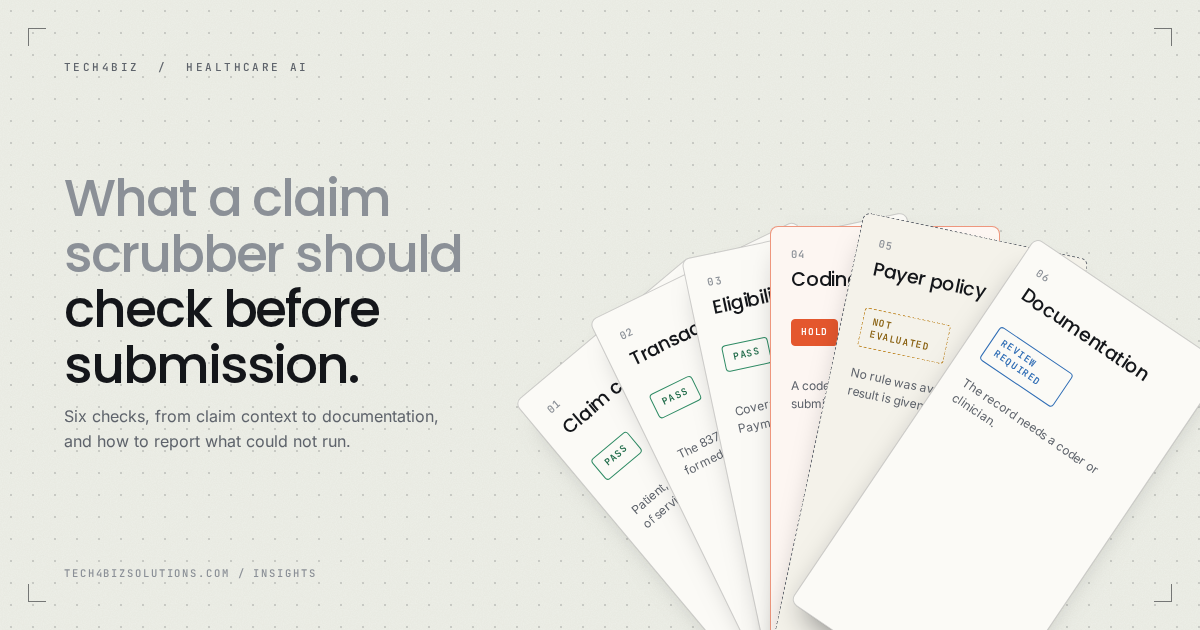
A claim scrubber can tell a billing team that a claim passed the rules it was given. The important question is whether those rules cover the risks that matter for that particular patient, service, payer and date of service.
A claim comes back with a denial, and the first reaction is often to ask why the scrubber did not catch it. The patient information was complete, the procedure code looked valid and the electronic claim had passed the checks the system ran. Yet the payer says the authorization does not match the service, the benefit does not cover the procedure in those circumstances, or the documentation does not support the code that was billed.
It is tempting to call that a failure of claim scrubbing, but the explanation is often more specific. The scrubber may have checked exactly what it was configured to check. It may never have been connected to the patient's current benefit information, may not have known which payer policy applied, or may have treated a code edit as proof that the clinical record supported the service. A green status therefore says very little until the billing team knows what was examined, which rule set was used and what remained outside the system's view.
That is the distinction that matters when an organization is choosing, configuring or building a medical claim scrubber. The goal is not to accumulate the largest possible library of edits. It is to run the right checks against the right claim context, explain the result in terms a biller can act on, and be explicit when a question cannot be settled automatically.
Start with the claim, not just the code
Before a scrubber can decide whether a rule applies, it needs to understand what kind of claim it is looking at. A professional claim, an institutional claim and a dental claim do not share the same structure, and even within one claim type the relevant rules can change with the payer, product, provider, place of service and date of service. If the system does not establish that context first, a perfectly accurate edit can still be applied to the wrong situation.
That context should include the payer and specific plan where available, the billing and rendering providers, the member identifier, the service location, the place of service, the date or dates of service, the claim type and the codes already assigned. For some workflows, it also includes the ordering or referring provider, authorization reference, network status and whether the service is being submitted as an original, corrected or replacement claim. These details are not administrative decoration: they determine which code set, coverage rule, authorization record and payer edit should be consulted.
The system should also be able to distinguish information that is known from information that has not been established. An absent payer identifier, for example, is not the same as a confirmed out-of-network status. A blank authorization field is not proof that authorization was unnecessary. Keeping those states separate prevents a downstream rule from treating missing context as a negative answer.
Check that the transaction is complete and internally consistent
The first group of checks is comparatively mechanical, which is why it is often where claim scrubbing begins. The scrubber should verify that required data elements are present, values are in the expected format, identifiers are structurally valid, dates make sense, and the claim follows the requirements of the transaction being generated. Where the organization sends electronic claims, this includes the applicable ASC X12 837 transaction and its implementation-guide requirements, not simply whether the file can be parsed as text.
A good validator should catch problems such as an invalid or missing identifier, a malformed date, a required segment that has not been populated, an impossible relationship between service dates and claim dates, or a value that does not belong to the relevant code set. It should also look for contradictions within the claim: a service line whose place of service conflicts with the claim context, a rendering provider who does not match the intended service, or a diagnosis pointer that refers to the wrong diagnosis entry.
These checks matter because a structurally defective claim can fail before a payer even reaches the question of coverage or payment. CMS describes Medicare electronic claim processing as a sequence: claims first pass basic HIPAA-standard edits, then implementation-guide edits, and then Medicare coverage and payment-policy edits. Errors at those stages can lead to batch rejection, claim-level rejection or denial, depending on the edit that was triggered. Passing one stage does not mean the later stages have been satisfied.
Medicare fee-for-service provides a useful example of why these acknowledgements must be interpreted at the right level. After an 837 claim is submitted to a Medicare Administrative Contractor (MAC), the MAC first runs front-end edits to check whether the file is readable and issues a 999 acknowledgement. If errors are found at this stage, the entire batch can be rejected for correction and resubmission. Claims that pass then move to claim-level checks against the HIPAA implementation-guide requirements; when errors are found, the affected claims are rejected and the submitter receives a 277CA Health Care Claims Acknowledgement. A claim that passes both early stages is accepted by the MAC and assigned a DCN for Part A or Home Health and Hospice claims, or an ICN for Part B claims. That acceptance is not a payment decision: CMS explains that Medicare coverage and payment-policy edits follow and can still result in an individual claim being rejected for correction or denied. The CMS March 2026 guide to checking Medicare claim status explains the acknowledgements and tracking numbers, while its overview of electronic health care claims describes the three edit levels.
Confirm eligibility and benefits, but do not confuse them with payment approval
Eligibility is one of the most useful sources of claim context, but it is often treated too casually. A real-time 270/271 eligibility inquiry can return information about whether a member is eligible and what benefits or cost-sharing information the health plan reports for a particular service type. That information can help a billing team catch an inactive policy, a member-ID mismatch or a benefit issue before the claim is prepared.
The same response has important limits: it is not a guarantee that the particular service will be covered or paid. Coverage can depend on the plan's terms, the diagnosis, the provider's network status, the place of service, frequency limits, medical-necessity criteria and other conditions that a general eligibility response may not resolve. A scrubber should therefore record what the transaction confirmed and when the response was obtained, while making clear which coverage questions remain unanswered; “eligible” and “payable” are not interchangeable statuses.
This distinction is also why eligibility verification and claim scrubbing should be connected but not treated as identical activities. A scrubber may use eligibility and benefit data as an input, while the underlying inquiry remains a separate transaction with its own response and freshness requirements. The user should be able to see whether the relevant benefit information was actually checked for the service in question or whether the system is relying on older registration data.
Apply coding edits to the right services and circumstances
Once the claim context and data structure are sound, the scrubber can move into coding validation. This is where it checks whether the reported diagnosis and procedure codes are valid for the applicable code set and date, whether the code combination is permitted, whether modifiers are used consistently with the documented circumstances, and whether units or other service details fall within the relevant coding rules.
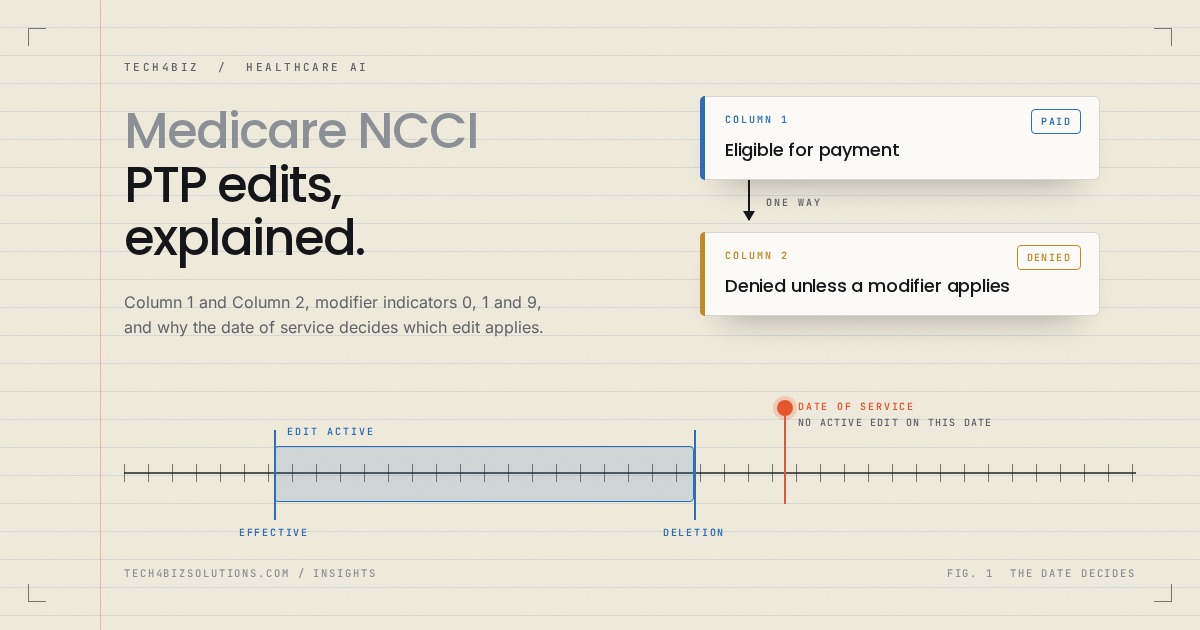
For Medicare claims, the National Correct Coding Initiative provides two important families of edits: Procedure-to-Procedure (PTP) edits, which identify code pairs that generally should not be reported together in the specified claim context, and Medically Unlikely Edits (MUEs), which address the units of service reported for a code by one provider or supplier for the same beneficiary on a date of service. CMS describes an MUE as the maximum number of units that would be reported on the vast majority of appropriately reported claims; MUEs may be applied at the claim-line or date-of-service level, not every code has one, and some values are confidential. These tools are important safeguards, but they do not replace a complete coding review or operate as universal rules for every commercial payer. Some plans adopt NCCI methodology, while others use different or additional requirements.
The scrubber should also check for code-specific instructions, add-on-code relationships, mutually exclusive services, modifier requirements and diagnosis-to-procedure relationships where those checks are supported by the applicable rules. A rule engine should not assume that every code pair is a simple “allowed” or “blocked” decision. Some edits permit a modifier in limited circumstances; others do not. The service, site, encounter, provider and supporting documentation determine whether an exception is appropriate.
The practical question is not whether the scrubber can find a code pair in a table. It is whether the system can explain which rule was matched, why the rule applies to this claim, whether an exception is permitted and what evidence a biller would need to examine before resolving the finding. CMS publishes the mechanics and current files through its Medicare NCCI PTP edits page and its NCCI FAQ library.
Match payer policy and authorization to the service being billed
A code can be valid and still fail a payer's coverage requirements. That is why a useful claim scrubber needs to look beyond code tables and check the policy conditions that apply to the member's plan and the service being submitted. Depending on the payer and service, those conditions may include covered indications, diagnosis requirements, frequency limits, provider qualifications, place-of-service restrictions, documentation requirements or prior authorization.
Authorization matching deserves particular attention because an approval is not a free-standing permission to bill any related service. The scrubber should compare the authorization record with the actual claim context: member, payer and plan, servicing or rendering provider, location, approved procedure or service, units or visits, effective dates and any relevant conditions. If the approved service differs from the code being billed, the dates do not overlap, or the provider or site does not match, the claim should be held for review rather than presented as clean simply because an authorization number is populated.
Medicare coverage checks have their own sources and boundaries. National Coverage Determinations set national Medicare coverage policy, while Local Coverage Determinations are made by Medicare Administrative Contractors for their jurisdictions. The applicable policy may also have associated billing and coding articles that explain how the coverage criteria are reflected in claims processing. A system that checks an LCD must know the relevant MAC jurisdiction and the policy's effective period; a system that checks an NCD must account for the national policy and associated implementation instructions. For commercial plans, the applicable coverage policy and medical policies may be different again.
A scrubber can automate the parts of these checks that are explicit. It can detect a missing authorization, compare dates or units, identify a procedure that is listed as requiring prior authorization, and flag a diagnosis or documentation requirement that has not been addressed. It cannot turn a policy summary into a final coverage decision when the policy depends on clinical facts or an exception that needs judgment. Where the rule is unclear, the documentation is incomplete or the payer must make the determination, the result should say so.
Use clinical documentation as evidence, not as a box to tick
The record is where a claim's codes and modifiers need to be supported, but checking a document's presence is not the same as confirming that it supports the billed service. A scrubber may verify that an operative note, order, referral or other required document exists; a more capable workflow can also identify relevant passages, extract key facts and compare them with the claim draft and configured policy requirements.
That is a useful role for AI, particularly when the evidence is buried in dictated notes, scanned records or long clinical documents. The model can help locate the stated procedure, anatomical site, laterality, date, diagnosis and other facts that a reviewer would otherwise have to find manually. It can flag a missing detail or a contradiction between documents, and it can link each extracted value back to the source passage so that the biller knows where it came from.
But a model's interpretation is not proof that medical necessity has been established. A note may contain the right words without satisfying the payer's actual criteria, and a model may miss a qualification, confuse a historical condition with the current encounter or infer something that the source never says. The appropriate system response is to surface the evidence and the uncertainty, not silently convert a plausible extraction into a definitive coding or coverage decision.
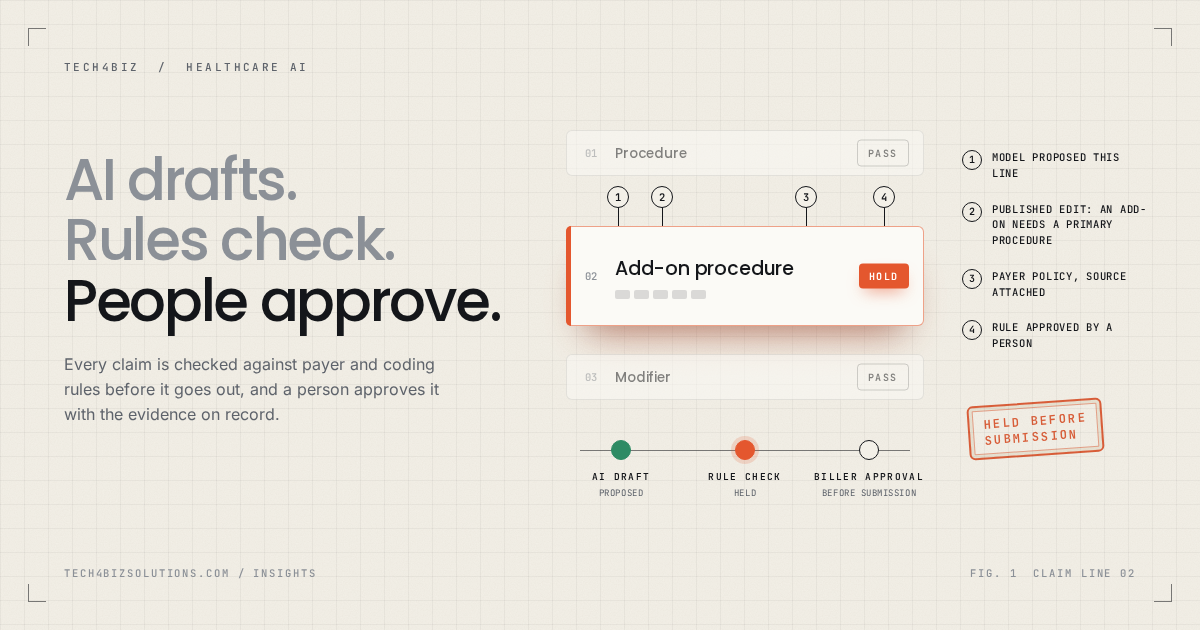
This is where the division of responsibility matters: explicit edits should run deterministically against approved rule versions, while AI assists with reading and organizing evidence; when a question turns on clinical ambiguity, a qualified person must resolve it and approve the claim before submission. That arrangement can make the work faster without pretending that every question has become a simple machine-readable rule.
Give the billing team a result they can act on
A scrubber should not return a single green checkmark when different classes of validation have different outcomes. A claim may pass transaction checks but fail a coding edit; it may pass the code checks but lack a required authorization; or it may have all configured rules pass while a clinical question remains unresolved. Those are materially different situations, and the interface should make them visible.
| Result | What it should mean | What the biller should be able to do |
|---|---|---|
| Pass | The configured check ran and found no issue within its scope | Review what was checked and continue to the next step |
| Hold | A potentially correctable issue or missing item prevents submission | See the reason, source and evidence needed to resolve it |
| Fail | A rule conflict or required condition has been identified | Correct the claim or route it to the appropriate specialist |
| Review required | The available information needs clinical, coding or payer judgment | Inspect the evidence and record the decision |
| Not evaluated | The system lacked the data, rule or integration needed to run the check | See the gap rather than treating the claim as cleared |
The finding should identify the claim field or service line involved, the rule that fired, the payer or program to which the rule belongs, the source document and version, the relevant effective date and the action expected from the reviewer. If the system suggests a correction, it should explain the basis for that suggestion and preserve the original value. It should never quietly change a code or modifier simply to turn a failed check into a pass.
The reviewer also needs a way to distinguish a rule result from a payer decision. A claim can pass the checks the organization has configured and still be denied after adjudication because a payer applies a policy or fact not available to the scrubber. A useful status describes the scope of validation honestly; it does not promise reimbursement.
Keep the rules current and make every result reproducible
A scrubber is only as reliable as the rule content it applies. Coding edits change, payer policies are revised, authorization lists are updated and effective dates rarely line up neatly with the date on which an administrator downloads a new file. Applying the most recently downloaded rule to every claim can therefore be just as wrong as applying an outdated one.
Each rule should have an identifiable source, owner, payer or program scope, version, publication date, effective date and, where applicable, deletion or retirement date. Updates should be reviewed and tested before they are activated, and the system should retain older versions so that a claim can be reconstructed against the rules that applied on its date of service. When the rule engine cannot determine which version applies, it should flag the issue rather than select one silently.
Testing should cover more than whether a rule imports successfully. The team needs examples where the rule should fire, where it should not fire, where a modifier or exception is valid, where data is missing and where the system should return “not evaluated.” Regression tests should be rerun when a code set or policy changes, and production findings should be monitored for false positives, missed denials, repeated overrides and rules that no longer reflect payer behavior.
This is where a claim scrubber becomes an operational system rather than a static checklist. Its value depends on how reliably it incorporates change, explains its findings and learns from the corrections made by billers without allowing an unreviewed pattern to become a new rule.
What to ask before buying or building a claim scrubber
A product demonstration can make claim scrubbing look straightforward: upload a claim, watch a list of edits run and see a clean or rejected result. A serious evaluation goes further by establishing which claim types and transaction versions the product supports, how it identifies payer, plan and provider context, and whether eligibility and authorization information are actually integrated or merely expected to be present in the claim. It should also be clear which coding edits are included, how their effective dates are handled and whether the vendor can show the exact source behind an individual finding.
The operational questions are just as important. A reviewer should be able to open the source policy or clinical passage behind a finding, distinguish a failed edit from a check that could not run, and see whether payer-specific rules can be approved and versioned by the organization. The product should also reproduce a result for a historical date of service, test updates before activation and preserve the original draft and validation history when a biller makes a correction.
Those questions reveal whether the system is simply a front-end data checker or a more complete pre-submission validation workflow. Both can be useful, but they solve different problems and should not be sold as though they offer the same assurance.
A clean claim should come with an explanation
The strongest claim scrubber is not the one that produces the most green indicators. It is the one that understands the claim well enough to choose the right checks, applies approved rules to the right payer and date, and shows the biller exactly what passed, what failed and what the system could not establish.
That requires more than a list of edits. It requires clean claim context, reliable transaction validation, current coding and payer rules, evidence that can be traced to its source, and a review workflow that gives people the authority to resolve uncertainty. When those pieces work together, the billing team gets a more useful claim before it leaves the organization, and the system avoids making a promise that no scrubber can honestly make: that every clean claim will be paid.
For RCM companies and healthcare software vendors, this is an engineering problem as much as a billing problem. The rules, integrations and evidence model have to fit the organization's actual payer mix and operating workflow. The best starting point is usually one recurring source of preventable rework, then a validation process that can be measured, governed and expanded without losing control of its decisions.
Frequently asked questions
What should a medical claim scrubber check before submission?
It should establish the claim context, then check the transaction, eligibility and benefit information, coding edits, payer policy and authorization, and clinical documentation. It should return a result that says what ran and what did not.
Is an eligibility response the same as payment approval?
No. A 270/271 eligibility response reports whether a member is eligible and what benefits the plan reports for a service type. It is not a guarantee that the particular service will be covered or paid.
Does receiving a 999 or 277CA mean the claim will be paid?
No. For Medicare fee-for-service, the 999 acknowledges the MAC’s initial file-level front-end edits; if errors are found there, the entire batch can be rejected. The 277CA reports claim-level errors found in the HIPAA implementation-guide edits. A claim that passes both early stages receives a DCN or ICN, but Medicare coverage and payment-policy edits still follow, so none of these acknowledgements guarantees payment.
What should a claim scrubber do when it cannot run a check?
It should return a not-evaluated result that names the data, rule or integration that was missing, so the biller sees the gap and does not treat the claim as cleared.
Why do scrubber rules need versions and effective dates?
Coding edits change, payer policies are revised and effective dates rarely match the day a file is downloaded. Each rule needs a source, version and effective date so a claim can be reconstructed against the rules in force on its date of service.
Improving pre-submission claim validation?
Review the checks your current process performs, the payer and policy data it depends on, and the exceptions your billers still resolve manually.
Discuss your healthcare workflowPrimary references: CMS MLN, Checking Medicare Claim Status (MLN3171902, March 2026) · CMS, Electronic Health Care Claims · CMS, Medicare Claims Processing Manual, Chapter 24 · CMS, HIPAA Eligibility Transaction System (HETS) · CMS, Operating Rules for Eligibility and Claims Status · CMS, Medicare NCCI PTP Edits · CMS, Medicare NCCI FAQ Library · CMS, Local Coverage Determinations · CMS, Medicare Coverage Database.