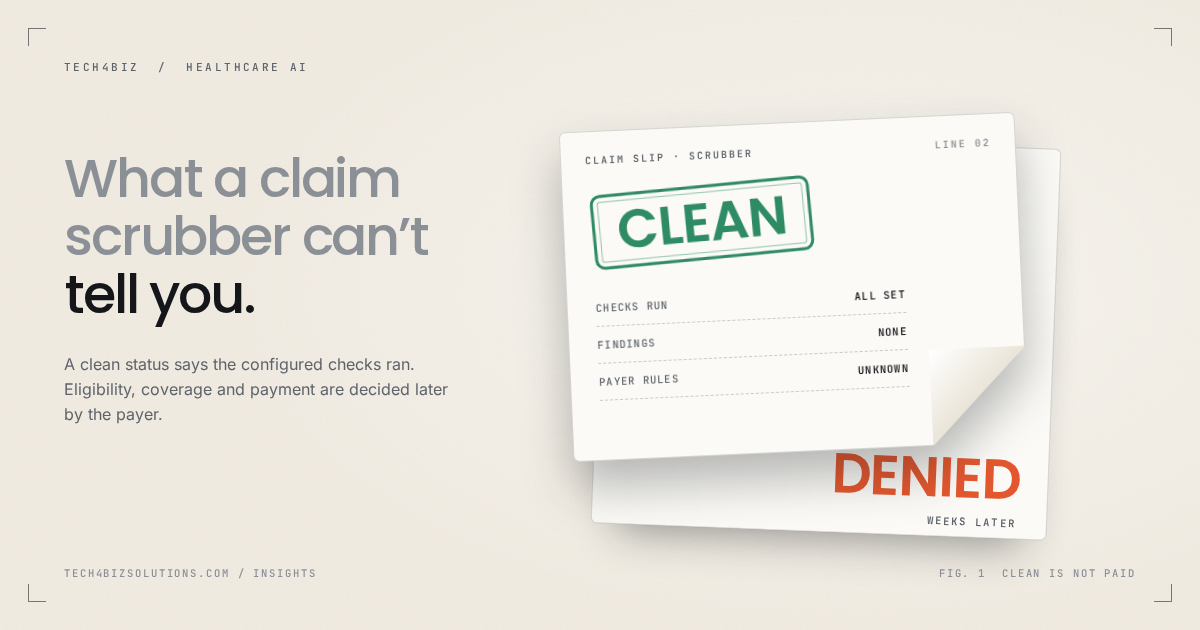
Medical claim scrubbing catches coding, data and format errors before a claim leaves the practice. A clean status says the configured checks ran. It does not say the payer will pay, which is why the checks, the rules behind them and the human review around them all matter.
A billing team prepares a claim. The patient information is present, the provider identifiers are valid and the procedure codes look right. The claim passes the practice's medical claim scrubber and shows a clean status, so it goes out.
A few weeks later the payer denies it. The service needed prior authorization, or the record did not satisfy a coverage requirement, or the payer applied an edit that the practice's own system never included. Someone now has to go back to the encounter, find the supporting records and decide whether to correct the claim or appeal it.
The scrubber probably did what it was configured to do. Medical claim scrubbing and getting paid are two different things, and the gap between them is where much of the rework sits.
This article explains what medical claim scrubbing checks, what a scrubber cannot know, and how to design claim validation that says plainly what it did and did not evaluate. It builds on our earlier piece on why a billing AI should not be the last check before a claim goes out.
What medical claim scrubbing is, and where it sits
Medical claim scrubbing is the review of a claim before submission to find errors, inconsistencies and likely payer-rule conflicts. A medical claim scrubber can sit inside a practice-management system, an EHR, a billing platform, a clearinghouse or a separate validation service. What it checks depends on the product and on how it is configured, so no single checklist applies to every scrubber.
The reason this matters is payer friction. In the 2026 Revenue Cycle Management Trends survey from Guidehouse and HFMA, 88% of 191 provider executives put payer challenges among their top three concerns. Among health systems, 81% reported rising denials and 74% reported longer prior-authorization delays. It is a survey of executives and not a census of US providers, but it describes the pressure that claim validation is meant to relieve.
The figure shows the underlying problem. A scrubber sits early, where it knows the encounter, the codes and the rules it was given. The decisions that settle payment, such as eligibility, coverage, authorization and plan terms, are made later by the payer, using information the scrubber may never see.
What a medical claim scrubber should check
A dependable scrubber works in layers, because a claim can fail for several different reasons, and each reason needs different evidence and sometimes a different reviewer.
| Layer | What it can identify | What it cannot guarantee |
|---|---|---|
| Data validation | Missing or inconsistent patient, provider and payer information | That coverage is active in every circumstance |
| Format validation | Missing segments, invalid values and structural errors in the 837 | Acceptance or payment by the payer |
| Coding validation | Invalid codes, conflicting code pairs, unit limits and modifier issues | That every code is supported by the record |
| Payer-rule validation | Configured coverage and billing requirements | That the payer will approve every exception |
| Authorization validation | Missing, expired or mismatched authorization details | That the final claim will be paid |
| Documentation support | Missing, contradictory or unsupported facts in the available records | A clinical medical-necessity decision |
| Human review | Context, exceptions and the decision to submit | Freedom from later payer disputes |
Patient, provider and claim data
The first layer checks that the information needed to identify and process the claim is present and agrees with itself. That covers subscriber and policy identifiers, the provider NPI and billing identifiers, the place and date of service, and the references between diagnoses and procedures. A good check goes beyond whether a field is filled in. An identifier can be present and still belong to the wrong insurance record, and a provider number can be well formed and still not belong to the billing entity on the claim.
Claim format and transaction structure
An electronic claim has to be built the way the receiving system expects. The X12 837 carries professional, institutional and dental claims from providers to payers, often through a clearinghouse, and Medicare fee-for-service uses the 837P and 837I as set out in its EDI companion guide. A claim can be clinically sound and still fail because a required segment is missing or a value is not permitted, so a scrubber checks structure as well as content.
Coding relationships: NCCI procedure-to-procedure edits
This is where medical claim scrubbing goes beyond formatting. A code can be valid on its own and still conflict with another code on the claim. For Medicare, the National Correct Coding Initiative publishes procedure-to-procedure edits, each with a Column One and a Column Two code. When a provider reports both codes of an edit pair for the same beneficiary on the same date of service, the Column One code is eligible for payment and the Column Two code is denied unless a clinically appropriate NCCI PTP-associated modifier is also reported.
Each edit carries a Correct Coding Modifier Indicator. An indicator of 0 means a PTP-associated modifier cannot bypass the edit. An indicator of 1 means a modifier may be used to bypass it in appropriate circumstances. An indicator of 9 means the use of such modifiers is not specified, according to the CMS NCCI FAQ library. CMS posts new files every quarter, and the Q4 2026 files took effect on 1 October 2026, so a scrubber has to apply the version that matches the date of service. The CMS PTP edits page lists the current and earlier files.
Coding relationships: medically unlikely edits
A medically unlikely edit, or MUE, sets the maximum units of service reported for a code on the vast majority of appropriately reported claims for the same beneficiary, provider and date of service, as the NCCI Policy Manual puts it. CMS says MUEs are not utilization edits, and Medicare contractors may apply unit limits stricter than the published MUE. CMS publishes separate files for practitioners, outpatient hospitals and DME suppliers, and it keeps some MUE values confidential, as its guide to the NCCI tools explains.
The MUE Adjudication Indicator decides how the edit behaves. An MAI of 1 is a claim-line edit, and appropriate modifiers can allow the same code on separate lines. An MAI of 2 is a date-of-service edit based on policy, which Medicare contractors describe as an absolute limit. An MAI of 3 is a date-of-service edit based on clinical benchmarks, and when records are submitted on reopening or redetermination the contractor reviews whether the units were furnished and medically necessary. A rules engine that treats every MUE as the same kind of ceiling will handle some of these cases wrongly.
Modifiers
Modifiers change how a service is read, and they are not a way to make a conflicting pair acceptable. The NCCI PTP-associated modifiers include anatomic modifiers, the global surgery modifiers 24, 25, 57, 58, 78 and 79, and 27, 59, 91, XE, XP, XS and XU. Modifiers 51, 80 and 82 are not on that list. CMS says modifier 59 may be used only if no other appropriate modifier describes the service, and the X modifiers XE, XP, XS and XU are more specific alternatives where one fits.
A scrubber can show the reviewer the rule that applies and the circumstances the modifier would have to reflect. It should not write a documentation rationale just because a modifier would clear the edit.
Payer coverage, eligibility and authorization
A claim can pass every coding check and still fail on coverage, eligibility or authorization. Those checks need their own rule sources. Checking that an authorization number is present is not enough. A useful check compares the coverage on the claim with the approved service, the performing provider, the validity period, the approved units and any conditions attached. Even then, a valid authorization does not guarantee payment, because eligibility, the service actually delivered, the final coding and plan terms still apply at adjudication.
Clinical documentation support
A claim can carry valid codes while the operative note or clinical record lacks what the coding or coverage requirement needs. The facts may be spread across operative notes, consultations, diagnostic reports and referrals. AI document processing can extract those facts and link each one to the passage it came from, and the validation layer can then report whether the expected information is present, missing or contradictory. That finding supports a reviewer. It is not a clinical medical-necessity decision, and a qualified person has to make that one.
One boundary applies across every coding layer. NCCI is a Medicare program, with a separate version for Medicaid. Some private insurers and managed-care organizations voluntarily adopt Medicare NCCI methodologies, but CMS does not control how they implement them, and a payer may apply additional or different edits. A scrubber needs to know which program and payer rules it is applying to each claim.
Why a clean status is not a paid claim
After submission a claim passes through several responses before any payment decision, and each one confirms something narrower than payment. Medicare fee-for-service, for example, returns a 999 implementation acknowledgment when a submission does not comply with the X12 005010 standard, and it uses the 277CA claim acknowledgment as part of its error handling, according to the Medicare EDI companion guide and CMS guidance on checking claim status. A 276 and 277 pair lets a provider ask for and receive claim status, and the 835 electronic remittance advice reports payment and adjustments.
The practical consequence is that a clean status at the scrubber and an accepted 277CA at the front end both mean that earlier checks passed. Neither says the payer has applied its coverage, authorization and payment rules. A validation system therefore needs to keep the claim, its validation results, the submission, each acknowledgement, any status response and the final remittance linked to one record, so that a denial can be traced back to the check that should have caught it.
How to design medical claim validation that explains itself
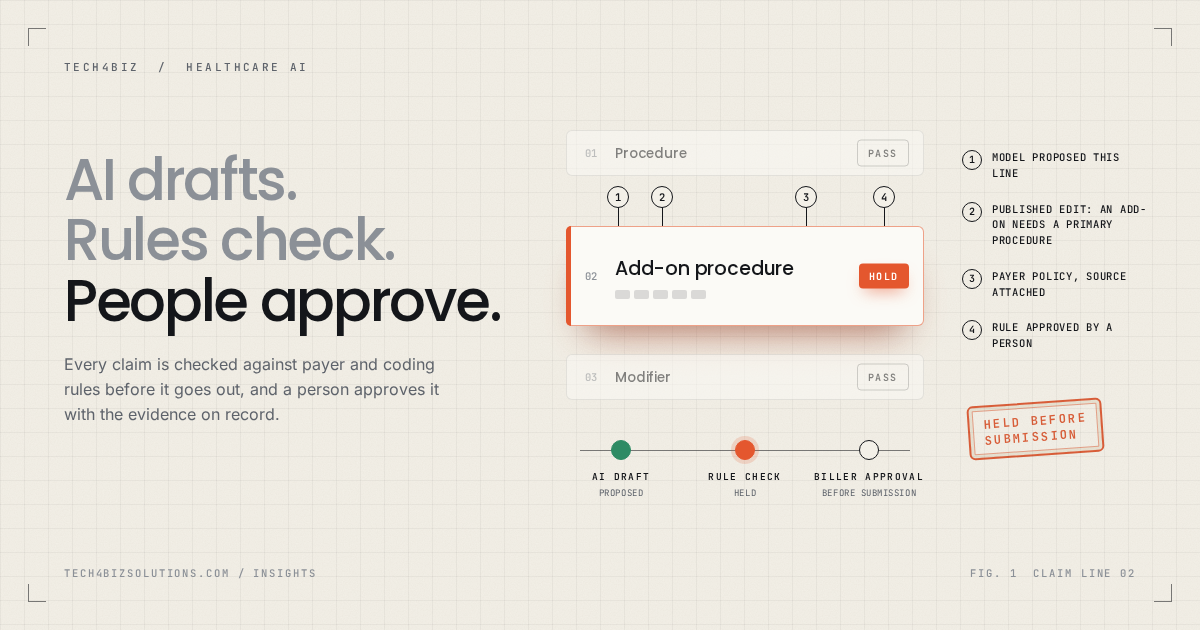
A better system works as a chain of controls and does not end in one green or red light. We describe the full architecture, with the model, the approved rules and the human review, in our earlier article. For the scrubbing step itself, six decisions matter most.
- Normalise the claim and keep the original. Convert incoming data to one internal form while preserving the source claim and its references, so the same checks work across EHRs, practice-management systems and billing platforms.
- Resolve the context first. Establish the payer, plan, program, provider, type of service and date of service before running any rule. A Medicare practitioner edit should not be applied to every commercial product.
- Return structured results. Each check should say what was checked, which rule and version applied, what triggered the result, why the claim was flagged and what correction or information is needed. Rules extracted from payer policies by AI stay proposals until an authorized person approves them.
- Tie documentation findings to evidence. Name the requirement, the document that might satisfy it and the passage that supports each extracted fact. When records contradict each other, show both versions.
- Report five outcomes. The figure below shows them. The last, not evaluated, covers a missing rule, payer detail or piece of evidence, and it must never be counted as a pass.
- Require human approval before submission. The reviewer should see the claim, the findings, the evidence and the rule behind each finding, and the review should work as a real control.
The fifth outcome prevents a common design mistake. If a scrubber reports no finding because it had no rule for the situation, the claim looks the same as one that was checked and found sound. Saying "not evaluated" keeps that gap visible to the person who has to decide.
Seven questions to ask before you buy or build a claim scrubber
A demonstration can make almost any validation system look convincing. A more useful test is what happens when a claim does not follow the expected path.
- Can it tell Medicare NCCI edits apart from commercial payer rules?
- Can it show which version of a coding edit or payer policy applied on the date of service?
- Can it explain why a claim was flagged and point to the rule?
- Can it connect a documentation issue to the exact source record or passage?
- What happens when a rule is missing, ambiguous or unsupported by the evidence?
- Can a biller correct an AI draft and have the correction recorded?
- Can the organization reconstruct the full decision and submission history later?
The answers say more about a system than the number of AI features on the demo screen.
Where AI helps with claim scrubbing, and where it should stop
AI is well suited to reading, extracting, classifying and comparing large volumes of text. It can read operative notes and clinical records, extract diagnoses, procedures and other clinical facts, spot missing information in a document package, compare payer policy language with existing rules and summarize a finding for a biller. It should not be the only authority for a coding rule, a medical-necessity decision or the decision to submit a claim. The dependable split is that AI reads and proposes, approved rules validate, and a person reviews and approves. That split also makes the system easier to measure, because extraction quality, rule execution, reviewer corrections and final outcomes can be assessed separately and not hidden behind one accuracy score.
Many organizations do not need another full revenue-cycle platform. They already run an EHR, a billing system, a clearinghouse and payer portals, and what is missing is a validation layer that connects them and fixes one weakness. For an RCM company that can mean a configurable rules engine across payer arrangements. For a specialty billing firm it can mean stronger extraction and validation for complex surgical documentation. For a healthcare software vendor it can mean adding claim validation or document intelligence without rebuilding the product.
At Tech4Biz we build AI document processing, configurable rule validation and integration-heavy workflows for complex enterprise operations. The work starts from the claims that are failing, why the current checks miss them and which part of the workflow to improve, and the choice of model comes after that.
Medical claim scrubbing: common questions
What is medical claim scrubbing?
Medical claim scrubbing is the review of a claim before submission to find errors, inconsistencies and likely payer-rule conflicts. It covers patient and provider data, claim format, coding edits and configured payer rules.
Does a clean claim status mean the claim will be paid?
No. A clean status means the configured checks found nothing to flag. Payment depends on eligibility, coverage, authorization, medical necessity and plan terms, which the payer applies at adjudication.
What is the difference between a claim scrubber and a clearinghouse?
The two roles overlap, and where the line falls depends on the product. A clearinghouse moves claims between providers and payers and checks that they are formatted correctly for transmission. A scrubber concentrates on coding, data and payer-rule checks before submission, and many products combine both.
Do all payers use Medicare NCCI edits?
No. NCCI is a CMS program for Medicare, with a separate version for Medicaid. Some private insurers and managed-care organizations voluntarily adopt Medicare NCCI methodologies, but their implementation and additional edits can differ.
Is a medically unlikely edit always a hard limit?
It depends on the MUE Adjudication Indicator. An MAI of 1 is a claim-line edit, and appropriate modifiers can allow the same code on separate lines. An MAI of 2 is a date-of-service edit based on policy. An MAI of 3 is a date-of-service edit based on clinical benchmarks, and supporting records can be reviewed on reopening or redetermination.
What should a claim scrubber do when it cannot check a rule?
It should report the check as not evaluated and send the claim to a reviewer. A check that did not run must never be counted as a check that passed.
Tech4Biz builds serious systems from silicon to cloud, engineered so the decisions that matter are provable, not just probable. If a process of yours depends on a model being right, talk to our engineers.
If your validation misses what the payer catches
Bring us the claims that keep coming back. Our engineers will work through the rules, the integrations and the evidence trail with you, starting from your real workflow.
Talk to our engineers ↗References: CMS, Medicare NCCI Procedure-to-Procedure Edits · CMS, Medicare NCCI FAQ Library · CMS, NCCI Policy Manual for Medicare Services, Chapter 1 (2025) · CMS MLN, How to Use the Medicare NCCI Tools · Noridian Medicare, Medically Unlikely Edits · CGS Medicare, Medicare FFS EDI Standard Companion Guide (276/277) · CMS MLN, Checking Medicare Claim Status (MLN3171902, March 2026) · Guidehouse, 2026 Revenue Cycle Management Trends · Becker's Hospital Review, What's stressing out revenue cycle leaders? (8 April 2026).