An MUE value can look like a simple daily ceiling, but Medicare adjudicates it according to the edit's scope and its MUE Adjudication Indicator. Understanding that distinction is essential when validating units, separating claim lines and deciding what evidence is needed when a service exceeds the published value.
A claim includes more units of a procedure or supply than Medicare usually sees for that code on a single day. The billing team has a straightforward question: should the claim be reduced to the published limit, split across lines, held for review or submitted with additional support? The answer depends on more than the number in the MUE table. It depends on what the code counts as a unit, whether the edit is applied to an individual claim line or to the date of service as a whole, and what kind of limit CMS has assigned to that code.
That is why a Medically Unlikely Edit should not be treated as a generic quantity cap. Medicare uses MUEs to identify reported units that are unlikely for the vast majority of appropriately coded claims, but the program deliberately distinguishes between claim-line edits, policy-based daily limits and daily limits based on clinical benchmarks. A system that treats all three as interchangeable can reject legitimate services, allow incorrectly reported units through, or give a billing team the wrong explanation for a denial.
What a Medicare MUE actually measures
A Medicare Medically Unlikely Edit is a unit-of-service check applied to a HCPCS or CPT code. CMS defines the MUE value as the maximum number of units that would be reported for that code on the vast majority of appropriately reported claims for services furnished by the same provider or supplier to the same beneficiary on the same date of service. Not every HCPCS or CPT code has an MUE, and the published value is not a statement that every claim at or below that number is correct.
The edit is designed to reduce payment errors caused by incorrect coding, clerical mistakes and implausible quantities. CMS develops MUEs using several kinds of information, including the code descriptor and CPT instructions, anatomical constraints, established Medicare policy, the nature of the service or procedure, the nature of an analyte or equipment, prescribing information, clinical judgment and claims data. The number is therefore tied to the way a service is defined and ordinarily reported, rather than being a simple statistical threshold applied without context. (CMS Medicare NCCI FAQ Library)
It also helps to separate an MUE from a Procedure-to-Procedure edit. A PTP edit evaluates the relationship between two different codes that appear together. An MUE evaluates the number of units reported for one code. A claim can therefore pass a PTP check and still exceed an MUE, or remain within the MUE while containing a PTP code pair that needs separate review. The two checks address different kinds of coding risk and should be evaluated independently.
There is another distinction that matters in practice: an MUE is a Medicare coding edit, not a general utilization guideline. CMS says providers should continue to report only services that are medically reasonable and necessary, and claims may still be selected for medical review even when reported units do not exceed the MUE value. Staying below the number is not a safe harbor, just as exceeding it does not automatically mean that every additional unit was medically impossible. The adjudication indicator tells you how the edit operates. (CMS Medicare NCCI FAQ Library)
Start with the unit of service, not the quantity on the invoice
Before comparing a claim with an MUE value, the system has to understand what one unit means for the code being reported. That sounds obvious, but HCPCS and CPT descriptors measure services in different ways. A unit may represent a milligram, a defined volume, an international unit, a time increment or a procedure. Counting physical items or reading a quantity field without interpreting the code descriptor can produce a technically precise comparison against the wrong unit of measure.
CMS provides useful examples in its NCCI FAQ. For HCPCS J1100, the descriptor refers to dexamethasone sodium phosphate per 1 mg, so the unit of service is 1 mg. For J0670, the descriptor reports mepivacaine hydrochloride per 10 ml, making 10 ml the unit. J7180 is reported per 1 international unit, while CPT 99292 represents each additional 30 minutes of critical care. In other words, the service quantity must first be converted into the unit the code actually represents before any MUE comparison is meaningful. (CMS Medicare NCCI FAQ Library, question 16)
For a claims platform, this means that the MUE rule should not be implemented as a field-level comparison that assumes every quantity is a count of identical items. The code, descriptor, unit conversion, submitted quantity and applicable date all need to be interpreted together. Where a code measures a drug by dosage, a device by anatomic quantity or a service by time, the calculation logic must respect that definition. If the source data does not provide enough information to establish the correct units, the safer result is to flag the claim for review rather than silently normalize the quantity.
MAI 1, 2 and 3: the indicator changes the outcome
Every published MUE has an MUE Adjudication Indicator, usually abbreviated as MAI. The indicator identifies the level at which the edit is adjudicated and, for date-of-service edits, whether the limit is grounded in policy or a clinical benchmark. MAI values are not billing modifiers; they are attributes of the edit that tell the claims-processing system how to evaluate the units.
| MAI | Adjudication scope | What the indicator means | What happens when units exceed the value |
|---|---|---|---|
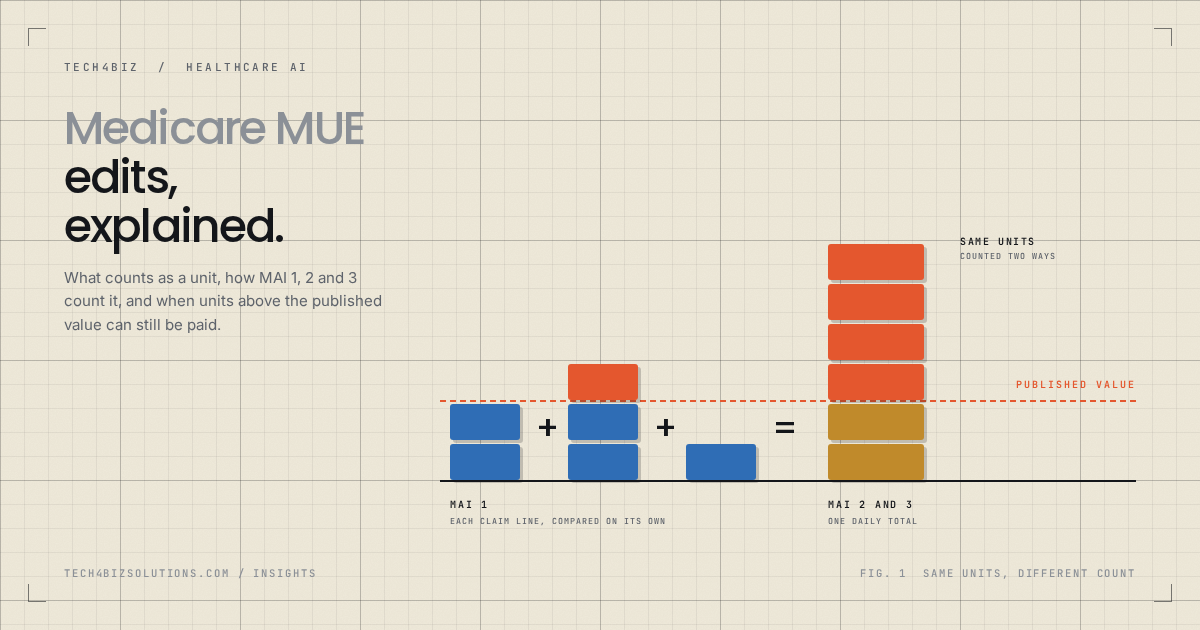
| 1 | Claim line | Each claim line is compared separately with the MUE value. | All units on an over-limit line are denied. Appropriate modifiers may support reporting the same code on separate lines when the circumstances genuinely warrant it. |
| 2 | Date of service | An absolute daily edit based on policy, such as an anatomical, code-definition, statutory, regulatory or published-policy constraint. | It is a policy-based limit. Additional documentation of medical necessity does not create a general exception to the underlying policy. |
| 3 | Date of service | A daily edit based on clinical benchmarks. More units may be possible, but are medically highly unlikely. | A Medicare Administrative Contractor may pay correctly coded and counted units above the value when adequate documentation establishes that the services were actually furnished and medically necessary. |
CMS describes MAI 2 edits as absolute date-of-service limits because units above the value would conflict with statute, regulation or binding subregulatory coding policy. Its example in the NCCI Policy Manual, Chapter 1 is CPT 94002, a code describing ventilation assist and management on an initial day: reporting two units would describe two initial days on the same date, which the code's definition does not allow. The issue is not simply that two units are uncommon; the code and governing policy do not describe two initial days on one date. (Medicare Claims Processing Manual, Chapter 23, section 20.9.3.2)
MAI 3 is different. These edits are also applied at the date-of-service level, but they are based on clinical benchmarks rather than an absolute policy restriction. CMS recognizes that a higher quantity may be possible in an unusual case, even though it would be medically highly unlikely in ordinary reporting. When the claim is appealed, the MAC may pay correctly coded and correctly counted units above the MUE if the record adequately supports medical necessity. CMS guidance also permits a MAC to bypass an MAI 3 edit during processing, reopening or redetermination when it has evidence that the units were actually furnished, correctly coded and medically necessary. (Medicare Claims Processing Manual, Chapter 23, section 20.9.3.2; CMS Medicare NCCI FAQ Library)
MAI 1 works differently from both daily edit types. It is evaluated at the claim-line level, which means the system compares the units on each line with the MUE value for that code. CMS explains that appropriate use of HCPCS or CPT modifiers to report the same code on separate lines can allow medically reasonable and necessary units above a claim-line MUE to be reported. That is not permission to split one continuous service into artificial lines simply to avoid an edit. CMS identifies modifiers such as 59, XE, XP, XS and XU, as well as 76, 77, 91 and anatomical modifiers, as examples that may be used for appropriate MAI 1 reporting, depending on the service and the reason for the separate line. The modifier and line structure must accurately represent what was performed, and the documentation must support their use; none of these modifiers is a general-purpose quantity workaround. Claims processing contractors also have rules that limit the use of these modifiers with some codes. CMS also states that a MAC adjudicating an appeal involving an MAI 1 or MAI 3 edit may pay correctly coded, correctly counted and medically necessary units above the MUE value. (CMS NCCI Policy Manual, 2026, Chapter 1; CMS Medicare NCCI FAQ Library, questions 4 and 5; Medicare Claims Processing Manual, Chapter 23, section 20.9.3.2)
Claim-line limits and date-of-service limits are not interchangeable
The practical difference becomes clear when the same code appears more than once on a claim. With an MAI 1 edit, each line is evaluated on its own. If one line exceeds the MUE, all units on that line are denied; a separately reported line may be adjudicated independently when an appropriate modifier and the underlying clinical circumstances support separate reporting. The edit is not simply adding every unit for the code together across the date.
With MAI 2 and MAI 3, the claims-processing system totals the units for the same HCPCS or CPT code reported by the same provider or supplier for the same beneficiary on the same date of service. Dividing the quantity among multiple claim lines does not change the daily total. A system that only checks each line independently could therefore miss a date-of-service edit, while a system that aggregates every MUE as a daily maximum could incorrectly block a valid MAI 1 reporting pattern.
The distinction also affects the explanation a claim scrubber should show. “Units exceed the MUE” is not a sufficient result on its own. A useful result identifies the code, MUE value, MAI, unit of service, claim-line or date-of-service scope, affected lines and the relevant rule version. For MAI 1, it should explain which line exceeded the value. For MAI 2 or 3, it should show the aggregated same-code units for the date of service and make clear whether the edit is policy-based or benchmark-based.
Choose the correct MUE file and effective version
CMS publishes separate MUE files for three service categories: Practitioner Services, Facility Outpatient Hospital Services and Durable Medical Equipment Supplier Services. The correct file depends on the claim-processing context. A practitioner MUE table is not a substitute for the outpatient hospital or DME table, and a Medicare table should not be reused as though it were a universal rule set for Medicaid, Medicare Advantage or commercial payers. Each program and payer has to be evaluated against its own applicable policies and data.
The MUE tables include the HCPCS or CPT code, the MUE value, the MUE Adjudication Indicator and a rationale category. CMS's educational guide explains how to read these fields and notes that the tables do not contain a modifier column, unlike the PTP code-pair files. A software implementation should therefore not attempt to infer modifier permission from the MUE table itself; modifier handling belongs in the applicable coding guidance and the workflow for the specific service. (CMS, How to Use the Medicare NCCI Tools)
CMS updates the MUE files at least quarterly, publishing additions, deletions and revisions for the three categories. As of November 11, 2026, the CMS MUE page lists the fourth-quarter 2026 tables for Practitioner Services, Facility Outpatient Hospital Services and DME Supplier Services as effective October 1, 2026 and posted September 1, 2026. A claim should be checked against the file applicable to its date of service, not simply against whichever file happens to be newest when the claim is processed. (CMS Medicare NCCI MUE page)
There is also a visibility limitation. CMS publishes most MUE values, but some are confidential and are not released publicly; CMS notes that the public or confidential status of values may change. A data pipeline should distinguish “no public MUE value found” from “confirmed no MUE applies.” Treating a public lookup miss as proof that the code has no MUE would overstate what the published data can establish. CMS's educational guide also notes that claims-processing contractors may apply their own unit edits; where a contractor edit and an MUE differ, the more restrictive edit applies. The MUE table should therefore be treated as one defined layer of Medicare coding validation, not as a complete inventory of every quantity control that may affect a claim.
What an MUE denial means for appeals and beneficiary liability
CMS characterizes a denial resulting from an MUE as a coding denial, not a medical-necessity denial. Its FAQ also states that an Advance Beneficiary Notice should not be issued on the basis of an MUE alone, because the notice does not shift liability to the beneficiary for units denied under the edit. This distinction matters operationally: an MUE denial should not automatically be routed into the same patient-liability workflow used for a medical-necessity determination. (CMS Medicare NCCI FAQ Library, question 10)
MUE denials may be appealed through the responsible Medicare claims-appeal process. The appeal should go to the appropriate Medicare Administrative Contractor or Qualified Independent Contractor, as applicable, rather than to the NCCI program contractor. That does not mean every MAI can be overridden by presenting more clinical notes. For MAI 3, documentation can support payment above the benchmark when it establishes that the units were actually furnished, correctly reported and medically necessary. MAI 2 requires more careful treatment because the edit reflects a policy restriction rather than a clinical benchmark. CMS notes that Qualified Independent Contractors are not bound by subregulatory guidance, but should understand the policy nature of the MAI 2 indicator when considering whether to pay units above the value on appeal. The practical point remains that medical-necessity notes do not create a routine bypass to an MAI 2 edit; the policy basis and the applicable appeal standard must be considered. (CMS, NCCI for Medicare; Medicare Claims Processing Manual, Chapter 23, section 20.9.3.2)
When an MAI 3 denial is under review, the evidence should make it possible to answer three separate questions: were the units actually furnished, were they reported using the correct code and unit definition, and were the services medically reasonable and necessary? A defensible record package may therefore need the relevant clinical notes, medication or supply administration records, procedure documentation, time records where the code is time-based, and a clear explanation of how the billed units were calculated. The precise supporting record depends on the service; the important point is that the documentation must support the actual units and the code used, not merely state that the quantity was required.
How an MUE-aware claim scrubber should work
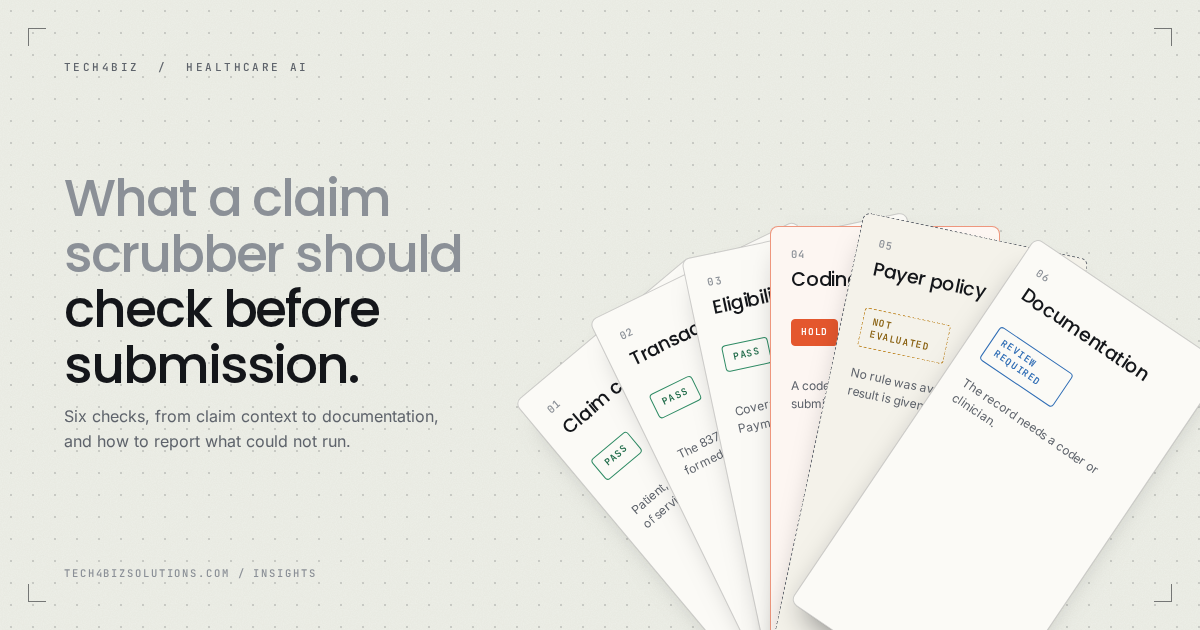
An MUE check is easy to describe as a comparison between a code and a number, but reliable implementation requires several decisions to be made in the right order. A robust claim-validation workflow should identify the claim context first, select the correct Medicare MUE file, and apply the file version that was effective on the date of service. It should then interpret the code descriptor to establish the unit of service, rather than assuming that the raw quantity field already uses the right measurement.
The adjudication logic must preserve the distinction between MAI 1 and MAI 2 or 3. For MAI 1, evaluate each line independently and recognize only those separate-line reporting patterns that are supported by appropriate modifiers and coding guidance. For MAI 2 and 3, aggregate units for the same code within the defined provider, beneficiary and date-of-service context before comparing the result with the daily value. MAI 2 and MAI 3 should then produce different explanations and different review paths: a policy restriction is not the same as a clinical benchmark that may be exceeded with sufficient evidence.
The rule result should be explainable and reproducible. Store the source file, service category, effective date, code, published value, MAI, rationale category, unit-conversion logic and the claim lines included in the calculation. When the rule file changes, retain the previous version so a reviewer can reconstruct the validation applied to an earlier date of service. This is particularly important when a claim is corrected, appealed or reviewed after a quarterly update has replaced the original table.
Finally, the scrubber should describe what it knows and what remains for a person to decide. It can identify a unit mismatch, an over-limit claim line, a date-of-service total that exceeds a policy edit, or a clinical-benchmark overage that needs documentation review. It cannot decide from the MUE number alone that a service was never performed, that the medical record is adequate, or that a payer will reimburse an unusual quantity. The result should support a qualified coder or billing professional, not replace that judgment.
The MUE value is not the whole coding decision
The most important lesson is that there is no single rule for “units above the MUE.” The result changes with the MAI. A claim-line edit can allow correctly reported units on separate lines when appropriate modifiers and real service circumstances support that reporting. A policy-based date-of-service edit is an absolute restriction under the underlying coding policy. A clinical-benchmark edit may be exceeded in an unusual case, but only when the evidence supports the units actually furnished, the code used and medical necessity.
That is why MUE logic belongs inside a broader pre-submission validation process rather than operating as a blunt quantity filter. The software should make the rule visible, apply it at the correct scope and preserve enough evidence for a human reviewer to understand the result. A clean claim is not created by forcing every number below a threshold; it is created by reporting the service accurately and applying the rule that actually governs it.
Frequently asked questions
Can Medicare pay for units above an MUE value?
It depends on the MAI. MAI 1 is a claim-line edit and appropriate modifiers may allow medically reasonable and necessary units to be reported on separate lines. MAI 3 is a date-of-service clinical benchmark that may be exceeded when adequate documentation supports correctly reported, medically necessary units. MAI 2 is an absolute date-of-service edit based on policy and is not a general exception pathway for unusual clinical circumstances.
Does an MUE apply to each claim line or the entire date of service?
MAI 1 applies at the claim-line level. MAI 2 and MAI 3 apply at the date-of-service level, where units for the same code are summed for the same provider or supplier, beneficiary and date of service.
Does staying below the MUE guarantee that Medicare will pay the claim?
No. CMS says MUE values are not utilization guidelines and do not remove the possibility of medical review. Other coding, coverage, medical-necessity and payment rules still apply.
Can an ABN transfer liability for an MUE denial to the beneficiary?
CMS says an ABN should not be issued based on an MUE alone. An MUE denial is a coding denial, and the ABN does not shift beneficiary liability for units denied under the edit.
What denial code does a Medicare MUE denial use?
For claims that fail an MUE because the units exceed the value, Medicare Administrative Contractors are instructed to assign CARC 151 with group code CO and MSN 15.6, and to deny the entire claim line or lines for that code.
Tech4Biz builds serious systems from silicon to cloud, engineered so the decisions that matter are provable, not just probable. If a process of yours depends on a model being right, talk to our engineers.
Building or integrating MUE validation?
The difficult work is rarely the comparison alone. It is defining the unit, applying the right scope for each MAI, keeping every quarterly version and returning a result that a biller can understand and a technical team can reproduce.
Discuss healthcare claims engineering ↗References: CMS, Medicare NCCI Medically Unlikely Edits (MUEs) · CMS, Medicare NCCI FAQ Library · CMS, Medicare NCCI Policy Manual, 2026, Chapter 1 · CMS, Medicare Claims Processing Manual, Chapter 23, section 20.9.3.2 · CMS, How to Use the Medicare NCCI Tools · CMS, NCCI for Medicare.