We started out assuming that the dangerous moment was the drop. Five rounds of checking sources later, the return looks like a problem of its own, and the rules being written for 2027 and 2028 are only beginning to address it.
The short answer is that the return is a risk of its own, and most of what is proposed for it is still a recommendation. When a large data center cluster moves to backup power during a grid fault, the load disappears in seconds. The sources we read describe a return that takes anywhere from seconds to hours, and a draft NERC paper warns that a simultaneous return can create a demand surge comparable to the original loss.
We wrote it the way we worked through it. Each round begins with something a reasonable engineer would believe, raises the strongest doubt we could find, checks it against NERC, PJM, ERCOT or Dominion material, and keeps only what survives. Every figure comes from the documents listed at the end, and where a document is a draft or preliminary we say so. Our companion article on grid stability and data centers covers the drop itself.
Round 1: Once the fault clears, the load comes back and the story is over
The belief. A fault lasts a fraction of a second. The load goes to backup power for a moment and returns, and the grid barely notices.
The doubt. How long does the return actually take?
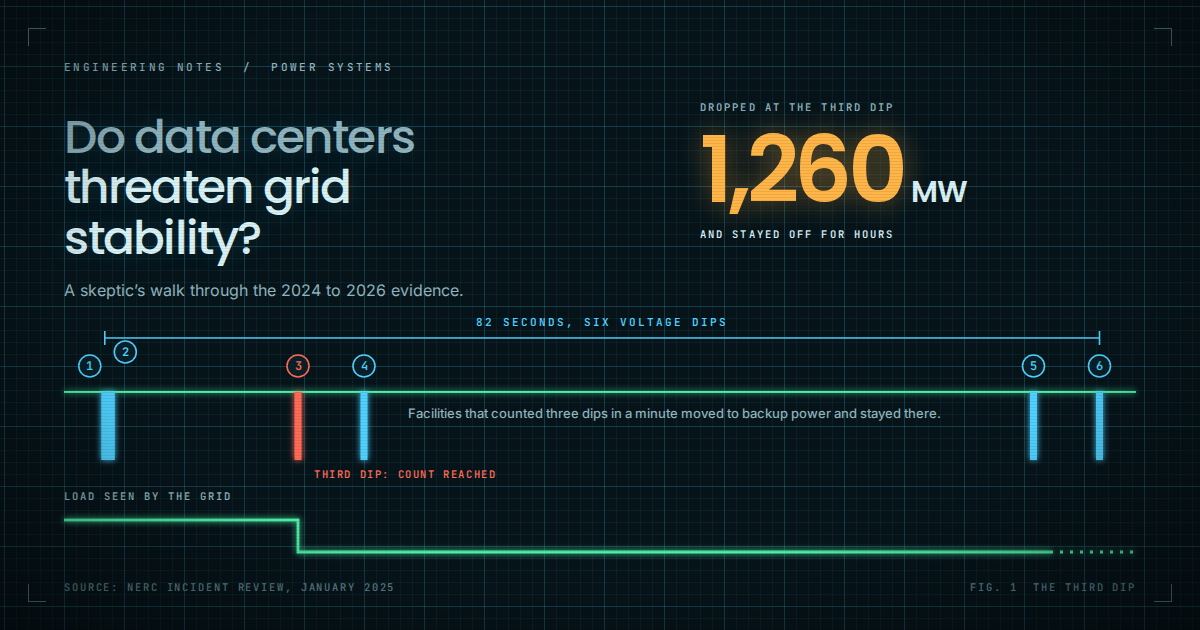
The evidence. NERC's January 2025 incident review of the July 2024 event describes three behaviors. A static battery UPS moves the load to the battery and returns it to the grid once voltage recovers. A rotary UPS with a flywheel and diesel engine typically has to be transferred back manually. A scheme that counts voltage disturbances keeps the load on backup until someone reconnects it by hand. In the July 2024 event, about 1,260 MW dropped off at the third voltage depression and did not return for hours.
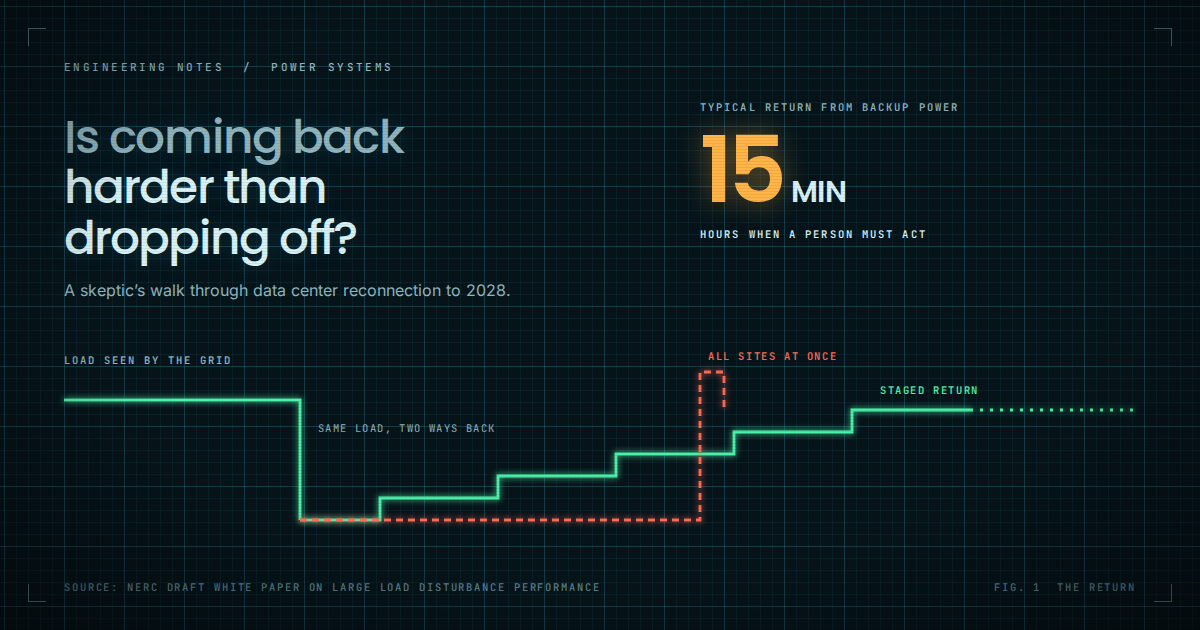
NERC's draft white paper adds the later Virginia events. After a May 3, 2025 fault, most of the affected load reconnected within 15 to 20 minutes, and the paper says restoration across events varied from seconds to minutes. Some sites on the same substation as sites that transferred rode through, and others reduced load briefly and ramped back to full output over several seconds. NERC's review of mining facilities in Texas describes two facilities after normally cleared faults: one needed nearly two hours to return to normal consumption, and the other was fully restored in about five minutes.
Dominion's preliminary findings for the July 22, 2026 event, presented to PJM's Operating Committee, give the sequence in seconds. The line first opened at 07:56:09 and reclosed instantly and tripped again. Breakers reclosed and opened again at 07:56:25 and 07:56:30. The initial load loss of 2,970 MW came at 07:56:33. The breakers reclosed and locked out at 07:57:25 and 07:57:30, and a secondary load loss of 1,099 MW came at 07:57:40. The cause of the line failure was mechanical: a single sub-conductor of a double bundle pulled free from its compression sleeve at a dead-end structure, apparently from overheating at a connection with improperly torqued bolts, with a formal root cause analysis scheduled for September 2026. Protection cleared every fault in two to three cycles, as designed. The slide that follows shows load dropping and returning. Its legend gives a minimum of about 1,440 MW and a maximum of about 3,760 MW for the Loudoun County aggregate, and a minimum of about 13,580 MW and a maximum of about 17,820 MW for the zonal load. Reading the chart, most of the load came back over roughly the next 15 minutes, and the rest within about half an hour. That reading is ours.
What survives. The return takes anywhere from milliseconds to hours, and the spread is set by the UPS design and by whether a person has to act. The July 22 line failure was an ordinary mechanical fault that protection handled correctly, so the whole event came from how the loads responded.
Round 2: A gradual return is harmless
The belief. If the load returns over minutes, the grid absorbs it as it absorbs any morning ramp.
The doubt. The drop and the return do not happen to the same grid. Generation has already adjusted to the loss by the time the load comes back.
The evidence. The draft white paper says it directly. When sites reconnect, whether after 15 minutes, which it describes as typical for UPS-supported sites returning from backup generation, or after several hours for sites needing manual intervention, the simultaneous reconnection of a large cluster creates a step increase in demand that the balancing authority must be prepared to manage. The paper says this surge can be comparable in magnitude to the original load reduction and arrives when generation dispatch may already have been adjusted to compensate for the loss. It calls coordinated reconnection protocols, including notification to balancing authorities and staged reconnection, necessary to prevent the recovery from becoming a second reliability event. The January 2025 incident review also said that load reconnection ramp rates are just as critical to operations as generation ramping, and that the July 2024 event had no significant reconnection issues, although the potential exists for future incidents.
The arithmetic shows why the pace matters. If about 3,800 MW returned over about half an hour, the average ramp would be about 127 MW per minute. If the same load returned in one minute the ramp would be 3,800 MW per minute, thirty times faster. These are our numbers, built from PJM's approximate event size and our chart reading.
The doubt that remains. In the events we have data for, the return looks gradual. NERC found no significant reconnection issue in July 2024, and the July 2026 chart shows a smooth climb. The warning is about a future event with more load, more synchronized sites and a faster return.
What survives. The return can become a second event, and its pace and coordination decide whether it does. The documented returns so far have been manageable.
Round 3: Ride-through rules will remove the drop, and the return with it
The belief. If loads simply ride through faults, there is no drop to recover from.
The doubt. Do the rules do that, and for which loads?
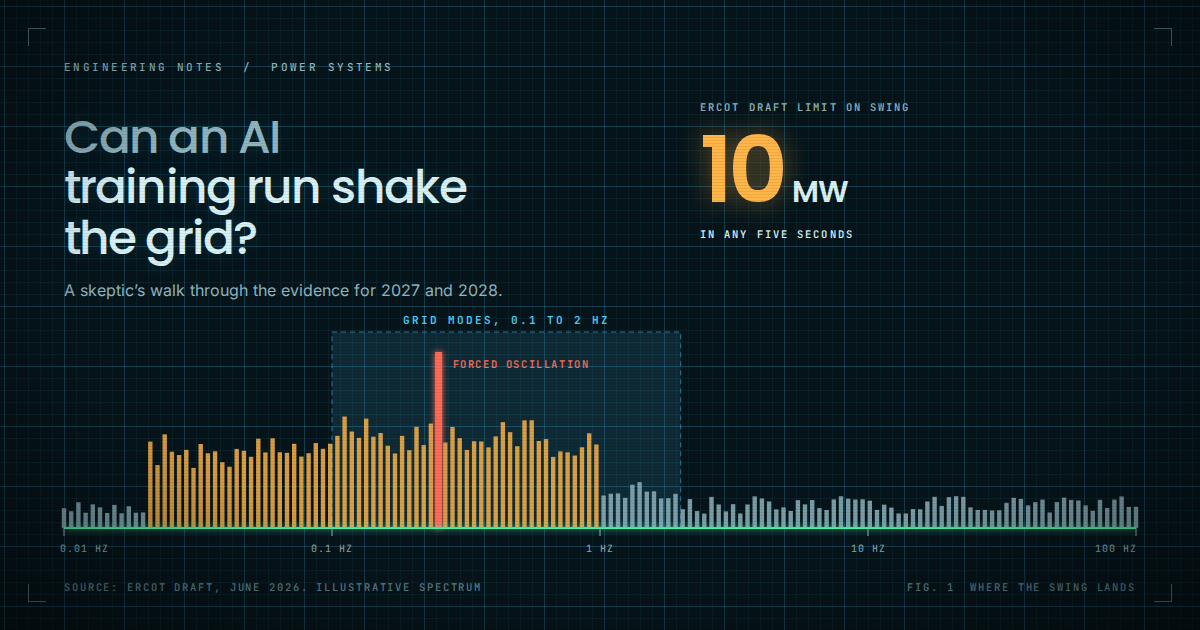
The evidence. ERCOT's NOGRR282, approved by the Public Utility Commission of Texas on July 9, 2026 and effective August 1, 2026, is the most detailed rule yet. Its voltage table requires a large computational load to remain connected for 1.0 second between 1.10 and 1.20 per unit, continuously between 0.90 and 1.10, for 2.0 seconds between 0.80 and 0.90, for 0.5 seconds between 0.50 and 0.80, for 0.25 seconds between 0.35 and 0.50, and for 0.15 seconds below 0.35. The July 2024 dips ran from 0.25 to 0.40 per unit for 42 to 66 milliseconds, so each one falls inside the table's ride-through region.
The rule also speaks to the counting scheme. A load shall not implement a trip or transfer scheme that disconnects it solely because of a certain number of voltage sags or swells in a period if it must ride through each one. If such a scheme must be used because of equipment limits, the load must stay connected through at least six sags or swells within 90 seconds. Where a load-transfer scheme is used for undervoltage below 0.8 per unit, it must begin returning to the grid within 0.25 seconds of voltage recovering above 0.9 per unit, and return to at least 90 percent of its pre-disturbance consumption within 0.5 seconds. A load that fails to ride through must report a root cause within 90 days, submit a plan within 90 days after that, and implement it within 180 days, and ERCOT may require disconnection if the load poses an imminent risk.
Three limits matter for the next two years. Loads that were operating or approved to energize, or had signed agreements and funded construction, on or before November 14, 2025 can be exempt. Before January 1, 2028, a load may trip or transfer for voltage above 1.08 per unit that lasts five seconds or more, if needed to protect voltage-sensitive equipment. And NERC's Phase 1 standards will not address minimum voltage or frequency ride-through, according to PJM's summary of NERC's plan; PJM says the NERC working group's disturbance performance paper is expected to become part of a reliability standard in 2027. The draft white paper recommends adopting the ERCOT requirements as the minimum baseline for North America, with changes: extend the requirement across the full duration of a multi-stage reclosing sequence, simplify the number of voltage-time steps, and allow case-by-case relief for cooling load. It also recommends a tiered applicability structure that covers the existing installed base.
The doubt that remains. The Virginia events involve loads that are already built. A rule that exempts earlier loads, or applies only to new interconnections, leaves them where they are until a standard reaches them.
What survives. Ride-through rules attack the drop, and for new loads in one region they now exist in final form. The installed base elsewhere is the open question, and so is the overvoltage exception that runs through 2027.
Round 4: Then coordinate the return
The belief. If reconnection is the risk, a protocol for reconnecting solves it.
The evidence. The pieces are appearing. NERC's Level 3 alert asks planners to collect the expected maximum ramp rate in megawatts per minute, up and down, and the voltage and timing at which a facility would reconnect. The January 2025 incident review asked operators to include ramp rates in operating agreements for connecting and reconnecting large loads. The draft white paper recommends that interconnection agreements for large sites require advance coordination with the balancing authority before reconnecting after any large event.
The doubt. Coordination is easy to ask for and hard to arrange. In the February 2025 event, about 1,800 MW of load transferred across 18 substations and 44 transformers, with most of the loss after the third voltage depression. The draft's Columbus, Ohio appendix compares ten data centers across three events. On the first, one site rode through a sag that fell to about 65 percent of nominal with no load reduction, while another that saw a worst sag of about 77 percent shed 70 MW. Neighbors on the same grid behaved differently, so a protocol has to work across many designs and owners at once.
What survives. Coordination is a tool that can be used now, before standards arrive, and it asks a lot of many separate operators. It will need to be written into interconnection agreements to be reliable.
Round 5: At least planners now know the size of the largest loss
The belief. The worst case is the biggest site.
The doubt. A single fault affected many sites at once.
The evidence. The draft white paper argues that planners should define the largest credible customer-initiated load reduction as a cluster-level contingency. In Northern Virginia a single line-to-ground fault on a 230 kV line produced simultaneous reductions from sites across 18 substations, an effective contingency of 1,500 to 1,800 MW that the paper describes as an order of magnitude larger than any single site. It asks balancing authorities with concentrations of computational load to test whether their reserves, including downward ramping capability, cover the largest credible event, and points to ERCOT's analysis setting 3.2 GW of simultaneous load loss as a reliability boundary. It also observes that a load reduction first produces over-frequency, so load shedding for under-frequency should not activate, but that an event coinciding with a generation loss could find the load it was meant to shed already gone. PJM's July 22 event was about 3,800 MW. The two systems are different sizes, so the numbers are not comparable directly, and they show the range planners are now discussing.
The doubt that remains. The cluster size depends on the fault location, fault type, system strength and the mix of protection settings in the area. A planner cannot read it off a single number.
What survives. The draft proposes moving the planning unit from the site to the cluster. It is a draft, and NERC's materials target publication in December 2026.
What to watch through 2028
- December 2026. NERC's disturbance performance white paper is targeted for publication, and NERC's Phase 1 standards are due to be filed with FERC by December 31.
- 2027. PJM says a NERC standard on minimum ride-through is expected. Whether it adopts ERCOT's table, and how it treats loads already built, will decide how much of the Virginia fleet the rules reach.
- January 1, 2028. ERCOT's overvoltage exception ends, and loads that satisfy the interconnection requirements after that date must continue consuming active power between 0.8 and 0.5 per unit voltage, reducing it only in proportion to the voltage drop.
- Reconnection protocols. Whether interconnection agreements start to require advance notice to the balancing authority before a return is the clearest sign that the surge risk is being taken seriously.
Six questions to ask about any large data center connection
These come from reading the sources side by side. They are our reading and not a checklist from NERC or ERCOT.
- After a transfer to backup power, what has to happen before the site returns to the grid, and does a person have to act?
- How long does the return take, in what steps, and at what rate in megawatts per minute?
- Does the site notify the balancing authority before returning after a large event?
- Do neighboring sites on the same fault return together, or is the return staggered on purpose?
- What does the site do when voltage rises after other loads drop away?
- Which requirements will apply to this site, and from what date?
The five rounds at a glance
| Round | The belief | What the evidence showed | What survived |
|---|---|---|---|
| 1 | The load comes back and that is the end | Returns ranged from seconds to hours, and 3,800 MW moved on July 22, 2026 | The spread comes from UPS design and manual steps |
| 2 | A gradual return is harmless | NERC's draft warns of a surge comparable to the original loss | The return can become a second event, and so far it has not |
| 3 | Ride-through rules remove the problem | ERCOT's rule is final and exempts earlier loads | New loads are covered, and the installed base is open |
| 4 | Coordinate the return | Ramp and reconnection data are being requested | Coordination is available now and hard to arrange |
| 5 | The worst case is the biggest site | A single fault moved sites across 18 substations | Planners are shifting to a cluster-level contingency |
Frequently asked questions
How long does data center load take to come back after a transfer to backup?
It depends on the design. NERC's draft white paper says about 15 minutes is typical for UPS-supported sites returning from backup generation and several hours for sites that need manual intervention. After a May 2025 event most affected load reconnected within 15 to 20 minutes, and in July 2024 about 1,260 MW stayed off for hours.
Can reconnection cause a grid problem?
NERC's draft white paper warns that simultaneous reconnection of a large cluster can create a step increase in demand comparable to the original load loss, and it recommends staged reconnection and advance coordination with the balancing authority. NERC's January 2025 review found no significant reconnection issues in the July 2024 event.
What does ERCOT's NOGRR282 say about schemes that count voltage sags?
It says a large computational load shall not use a trip or transfer scheme that disconnects it solely because of a number of voltage sags or swells in a period if it must ride through each one. If such a scheme must be used because of equipment limits, the load must stay connected through at least six sags or swells within 90 seconds.
Which data centers does NOGRR282 cover?
It covers large computational loads in ERCOT, with exemptions for loads that met defined conditions on or before November 14, 2025, such as being operational or approved to energize. Some of its requirements also change on January 1, 2028.
What is the largest credible load loss for planning?
NERC's draft white paper proposes treating it as a cluster-level contingency, because one fault can move many sites at once. In Northern Virginia a single fault produced simultaneous reductions across 18 substations, and the paper asks balancing authorities to check their reserves against such an event.
Working through a large load interconnection?
If you are working on load models, ride-through studies or commissioning for a large computational load, we are glad to compare notes.
Talk to our engineers ↗References: NERC, Incident Review: Considering Simultaneous Voltage-Sensitive Load Reductions (January 2025) · NERC LLWG, Large Load Disturbance Performance: Impact Analysis and Ride-Through Recommendations, draft white paper (2026), a draft for comment · NERC, Incident Review: Voltage-Sensitive Crypto Load Reductions (January 9, 2026) · PJM, Dominion July Loss of Load Event, Operating Committee presentation with Dominion preliminary findings (August 6, 2026) · ERCOT, NOGRR282 issue page, including the PUCT report of July 9, 2026 · NERC, Level 3 Essential Action Alert: Computational Load Modeling, Studies, Instrumentation, Commissioning, Operations, Protection, and Control (May 4, 2026).