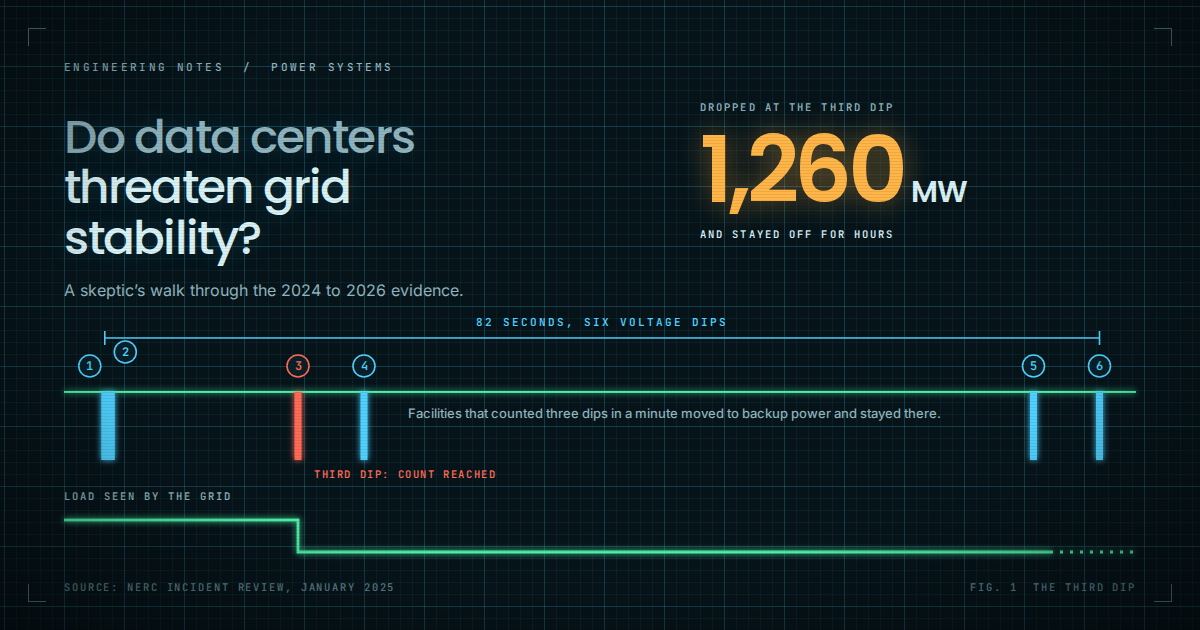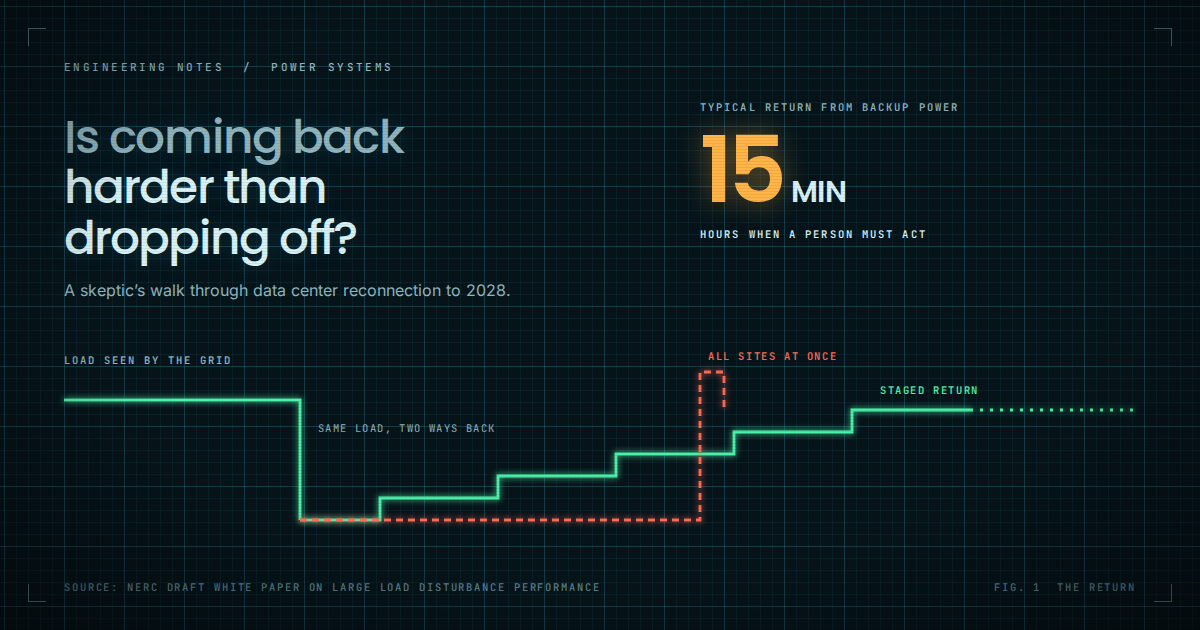
We started out doubting that the power swings of AI training were a grid problem at all. Five rounds of checking primary sources later, part of that doubt held and part did not, and the rules now being written for 2027 and 2028 reflect both.
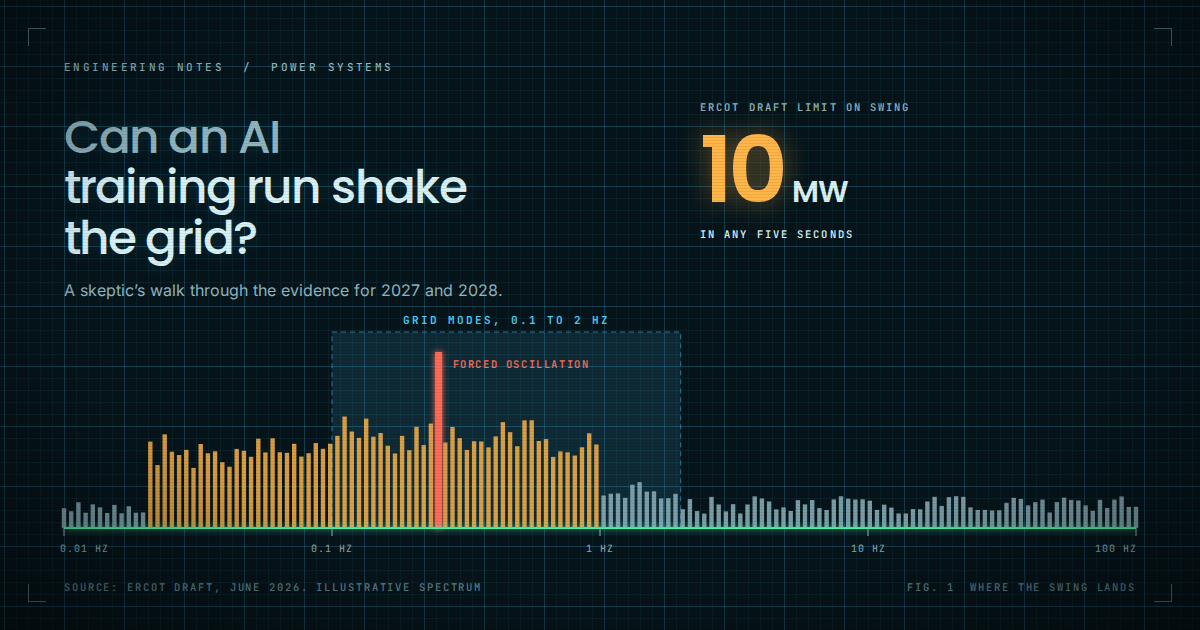
The short answer is that none of the documents we read attributes a grid event to the rhythm of an AI training job, and grid operators are writing limits for that rhythm anyway. ERCOT has drafted a cap of 10 MW of swing in any five seconds, and NERC's May 2026 guideline names AI data centers among the loads that can introduce forced oscillations. Both things can be reasonable at the same time, and this article explains why.
We wrote it the way we worked through it. Each round begins with something a reasonable engineer would believe, raises the strongest doubt we could find, checks it against NERC, ERCOT, NVIDIA or a published paper, and keeps only what survives. Every figure comes from the documents listed at the end, and where a document is a draft we say so.
Round 1: A training job draws steady power, like any other large computer load
The belief. A cluster that runs for weeks draws a roughly constant amount of power, and the grid sees a flat line.
The doubt. Thousands of GPUs run the same program, and a program has phases. If the phases line up, the line may not be flat.
The evidence. A 2025 paper by engineers at Microsoft, OpenAI and NVIDIA describes the pattern. Each training iteration has a compute-heavy phase and a communication-heavy phase. Power in the compute phase can approach a GPU's thermal design power, and power in the communication phase can fall close to idle. GPUs make up more than half of the provisioned power in a server. Because the nodes in a job are co-located and synchronized, their swings add up at rack, data center and grid levels. The authors say that at scale the swings can amount to tens or hundreds of megawatts, and that depending on the job they can repeat from about once per second to once every tens of seconds. NERC's July 2025 white paper shows an example training load profile over two minutes and over five seconds, and describes AI data center profiles as periodic, repetitive and sustained.
The reason synchrony matters is arithmetic. Suppose each GPU swings by 1 kW from peak to trough, which is an assumption for illustration. If the swings are unrelated to each other they partly cancel, and the combined swing grows with the square root of the number of GPUs. If they move together, the combined swing grows in direct proportion. At 10,000 GPUs that is about 100 kW against 10 MW. At 100,000 GPUs it is about 316 kW against 100 MW.
What survives. A training cluster is not a flat load, and the size of its swing depends mostly on how well the GPUs stay in step. The paper reports the authors' observations, and the numbers will differ from one job and one facility to the next.
Round 2: Tens of megawatts is small next to an interconnection
The belief. The Eastern Interconnection carries hundreds of gigawatts. A swing of tens of megawatts disappears into it.
The doubt. Size may not be what matters. Frequency may matter more.
The evidence. NERC's white paper makes the point with an event that involved no data center. In 2019 a steam turbine in Florida created a forced oscillation with an amplitude of 200 MW at 0.25 Hz. The Eastern Interconnection has an inter-area mode at roughly that frequency, so the oscillation spread across the whole interconnection, and oscillations as large as 50 MW were seen in New England. It lasted 18 minutes, and no outages or damage were reported. The paper adds that forced oscillations at the torsional frequencies of a turbine-generator can produce persistent torque pulsations, such as 30 percent peak to peak in its arc furnace example, and fatigue the turbine.
NERC's May 2026 reliability guideline states the same concern for data centers. Loads with variable and cyclical profiles, such as AI data centers and electric arc furnaces, can introduce forced oscillations, and if the load cycles in the electromechanical range of 0.1 to 2 Hz there is a potential for interacting with natural low frequencies and causing widespread forced oscillations. The guideline says such oscillations should be studied before the loads are energized.
ERCOT has done the generator side of the arithmetic. Its February 2026 presentation screened power variations at every bus of 100 kV and above and found that the number of affected generator stations rises sharply as the injected variation grows. It assumed a maximum continuous terminal variation of 1 percent of a generator's rating. In ERCOT's worked example, a generator with an endurance limit of 0.1 per unit and a load shape ratio of 10 can tolerate 0.01 per unit, which for a 100 MW generator is 1 MW of continuous oscillatory power at its terminals.
The doubt that remains. Whether a swing is dangerous depends on where its frequency lands relative to a mode, and on how lightly that mode is damped. For a second-order mode, the textbook response at resonance is about 1 divided by twice the damping ratio, so a damping ratio of 0.05 would amplify a forcing at that frequency about ten times. That is our arithmetic for illustration and not a figure from the sources.
What survives. Comparing a swing with the size of an interconnection hides the issue. What matters is the swing's frequency, the damping of nearby modes and the generators close to the load. The 2019 event shows an oscillation crossing a continent with no damage, which is both reassuring and a warning about how far one can travel.
Round 3: If this were real, it would already have happened
The belief. No event, no problem.
The doubt. Has it really not happened?
The evidence. NERC's white paper documents data center oscillations that were not the training rhythm. In 2023 a large data center in the Midwest produced unexpected forced oscillations: its power electronics perturbed the system at one-second intervals, a forcing at 1 Hz, and each perturbation produced a well-damped 11 Hz ringdown. The paper also says that in the Dominion system oscillations have been seen arising from the interaction of data centers' UPS input units. The May 2026 guideline adds that dynamic control interactions have been demonstrated to cause oscillations at one cryptocurrency mining facility in ERCOT and one data center in Dominion. ERCOT's September 2026 board update says large loads, particularly those associated with AI training, are capable of producing rapid fluctuations in active power consumption.
The doubt that remains. In every documented case the cause was a control or UPS interaction. NERC's draft white paper also notes that Northern Virginia's data center load is primarily conventional data centers and not AI-focused computing campuses. In the documents we read, none attributes a grid event to the rhythm of a training job.
What survives. Data center oscillation is documented, and a training-specific event is not. The distinction matters, because the proposed limits are written for the training rhythm on the strength of a mechanism, and the evidence for the mechanism in a real grid is still thin.
Round 4: Better hardware will smooth it out
The belief. The vendors have already fixed this.
The evidence. NVIDIA's July 2025 post on the GB300 NVL72 describes three tools. A power cap limits GPU draw at the start of a workload and raises it gradually, in line with ramp rates the grid can tolerate. Electrolytic capacitors in the power shelf provide 65 joules of energy storage per GPU, taking about half of the power supply's volume. A hardware power burner tapers the draw when a workload ends and then disengages. NVIDIA reports that the energy-storage power shelves reduced peak grid demand by 30 percent when training the Megatron LLM, compared with the previous GB200 power supply, and substantially dampened rapid fluctuations. The storage is used only to shape the load the grid sees, and it does not send energy back to the utility. The 2025 paper compares three levers: software changes, GPU firmware that enforces ramp limits and power floors, and rack-level energy storage.
Sixty-five joules is not a lot of energy. For a GPU drawing 1 kW it would last 65 milliseconds. Taking a swing as a sine wave of amplitude 0.5 kW, which matches the 1 kW peak-to-peak assumption in Round 1, the energy needed to buffer one half-cycle is the amplitude times the period divided by pi. That is about 64 joules for a 0.4 second period, about 160 joules for a 1 second period and about 1,600 joules for a 10 second period. Across the 0.1 to 2 Hz band of concern, the same swing needs roughly 80 to 1,600 joules per GPU, which is about 1.2 to 24 times the 65 joules.
The doubt that remains. NVIDIA describes the storage as a fast transient solution, and our arithmetic suggests it covers only the fastest swings. The 30 percent figure is a reduction in peak demand on one workload, which is a different quantity from the amplitude of an oscillation at 0.2 Hz. The 2025 paper gives an example of the gap: if a utility allowed only a 10 MW dynamic range on a 100 MW job, that would be 10 percent, which the authors say GPU power smoothing could not meet at the time of writing.
What survives. The hardware is moving in the right direction, and the timescales explain why several levers are needed together. Fast transients, ramps and slow swings each call for a different one.
Round 5: Regulation will sort it out
The belief. Grid operators will set a limit, and that settles it.
The evidence. ERCOT's February 2026 presentation proposed that load power shall not repetitively exceed a 10 MW change in a sliding window of 5 seconds. Its June 2026 draft language is more precise: the peak-to-peak value of active power variation, calculated from instantaneous voltages and currents and filtered to preserve frequency components from 0.1 Hz to 55 Hz, shall not exceed 10 MW over any rolling 5-second interval. ERCOT told its board in September 2026 that its draft revision request, Large Load MW Variation Requirements, will recommend that limit, and that it planned to submit it in September or October. ERCOT also says high-resolution measurement such as PMU data will be needed. The NERC guideline recommends that planners set oscillation attenuation metrics and amplitude limits for large loads, and that developers disclose cyclical demand ramps and their frequencies, especially in the sub-synchronous range.
The doubt. ERCOT's number comes from its own screening of its own generators. NERC's draft white paper allows regional modification of the minimum requirements it recommends for ride-through, which suggests that other regions may not adopt the same number. We could not confirm from the sources whether the revision request has been filed.
What survives. A concrete proposal exists in one region, with its reasoning published. Whether it becomes a rule, and whether other regions copy it, is open.
One job, several sites
One line in NERC's guideline deserves more attention than it gets. It asks developers to disclose when multiple data centers are used for the same training process, because an interruption at one data center can cause demand changes for all the connected data centers. That makes a disturbance near one campus a possible trigger for load changes at others, which is a question for planners to study. The sources we read do not say whether it has happened.
What to watch through 2028
- ERCOT's variation revision request. It was planned for September or October 2026. Its text, its exemptions and whether it applies to loads already connected will show how seriously the 10 MW number is meant.
- NERC's disturbance performance white paper. NERC's materials target publication in December 2026. It is about ride-through and recovery, and it will show how NERC treats the existing fleet.
- Measurement. ERCOT says PMU-class data is needed, and NERC's guideline says high-speed recorder data should be collected to study cyclical demand. How many sites actually record at that speed is something to watch.
- A first attributed event. The first published event analysis that ties a grid oscillation to the rhythm of a training job, if one appears, would change the weight of every round above.
Five questions to ask about any large training facility
These come from reading the sources side by side. They are our reading and not a checklist from NERC or ERCOT.
- What is the peak-to-peak swing at the point of interconnection, and over what range of periods does it occur?
- Is that swing recorded at a speed that would catch the frequencies of concern, or only at slower rates?
- Which smoothing tools are active, and over what timescales does each one work?
- Do the facility's power supply and UPS input controls interact with the grid's local modes?
- Is the same training job spread across more than one site, and if so how do the sites respond together?
The five rounds at a glance
| Round | The belief | What the evidence showed | What survived |
|---|---|---|---|
| 1 | Training draws steady power | Compute and communication phases swing power, and synchrony adds the swings up | The load is not flat, and synchrony sets its size |
| 2 | Tens of MW is too small to matter | A 200 MW oscillation at 0.25 Hz crossed an interconnection in 2019 | Frequency and damping matter more than size |
| 3 | No event means no problem | Data center oscillations are documented, from control and UPS interactions | The mechanism is credible, and a training-specific event is not documented |
| 4 | Hardware has fixed it | 65 J per GPU of storage and a 30 percent peak reduction | Fast transients are covered, and slower swings need other tools |
| 5 | A regulation will settle it | ERCOT drafted 10 MW in any 5 seconds | A proposal exists, and its fate is open |
Frequently asked questions
Can AI training cause power oscillations on the grid?
A 2025 paper by Microsoft, OpenAI and NVIDIA engineers says synchronized training can produce swings of tens or hundreds of megawatts at scale. NERC's May 2026 guideline says AI data centers can introduce forced oscillations if their cycling falls in the 0.1 to 2 Hz range. The documents we read do not attribute a specific grid event to the rhythm of a training job.
What is ERCOT's proposed limit on large load power swings?
ERCOT's June 2026 draft language says the peak-to-peak value of active power variation, filtered to frequencies from 0.1 Hz to 55 Hz, should not exceed 10 MW over any rolling 5-second interval. In September 2026 ERCOT told its Board it planned to submit the revision request in September or October.
What is a forced oscillation?
A forced oscillation is a repeating power signal that a source such as a load injects into the grid, as opposed to an oscillation the grid sustains by itself. NERC says it matters most when the signal's frequency matches a natural mode of the system or a turbine.
Does NVIDIA's GB300 power smoothing solve the problem?
NVIDIA reports a 30 percent reduction in peak grid demand in a training test, using power caps, energy storage in the power shelf of 65 joules per GPU and a power burner. NVIDIA describes the storage as a fast transient solution, and our arithmetic suggests it covers only the fastest swings.
Do the documented data center oscillations come from AI training?
The events NERC documents involve power electronics and UPS interactions, such as a 1 Hz forcing at a Midwest data center in 2023. NERC's draft white paper also says Northern Virginia's data center load is primarily conventional data centers and not AI-focused campuses.
Working through a large load interconnection?
If you are working on load models, ride-through studies or commissioning for a large computational load, we are glad to compare notes.
Talk to our engineers ↗References: Choukse et al., Power Stabilization for AI Training Datacenters, arXiv:2508.14318 (2025) · NERC, Characteristics and Risks of Emerging Large Loads, white paper (July 2025) · NERC, Reliability Guideline: Risk Mitigation for Emerging Large Loads (May 2026) · ERCOT, Large Load Power Variation Requirement Consideration, LLWG (February 19, 2026) · ERCOT, LCL Power Variation Limit Discussion, LLWG (June 19, 2026) · ERCOT, Interconnection and Grid Analysis Update, Board of Directors (September 2026, revised) · NVIDIA, How New GB300 NVL72 Features Provide Steady Power for AI (July 28, 2025) · NERC LLWG, Large Load Disturbance Performance: Impact Analysis and Ride-Through Recommendations, draft white paper (2026), a draft for comment.